Abraham S. Barkelew was an enslaver and yeoman who resided in North Brunswick, NJ, in the early 19th century. His family was associated with the area of North Brunswick Township known today as South River.
His family name is variously spelled as Barkelew or Buckelew in historical records.
Abraham Schuyler was a resident of Middlesex County, New Jersey. He served as the Justice of the Peace for the county in the early 19th century. In this official capacity, he issued manumission certificates for residents of North Brunswick whose enslavers agreed to set them free.
Abraham Schuyler Neilson (1792-1861) of New Brunswick, NJ, owned at least two enslaved people according to the 1830 federal census. He was the son of Colonel John Neilson (1745-1833), a Revolutionary War hero from New Brunswick. Abraham was the younger brother of James Neilson (1784-1862), a benefactor of Queen's College (Rutgers).
He appears to have been working for a distant cousin named James H. Neilson in the 1820s. A manumission record from 1822 refers to Abraham as "Abraham S. Neilson of the firm of James H. Neilson." The firm of James H. Neilson is not to be confused with the business of Abraham's brother James Neilson (who did not typically use a middle initial). The James H. Neilson referred to here is likely the son of William Neilson (c. 1737–1820), a prominent New York City merchant.
Abraham Shaver (1754-1820) was an enslaver who resided in Stillwater, Sussex County, NJ. He was a prosperous mill owner and a prominent civic leader; he served as an assemblyman in the state legislature in the early 1800s.
His family name was variously spelled Shaver, Shafer, or Schaeffer in local histories and archival documents. He was the son of Casper Schaeffer (1712-1784), a German immigrant who was one of the founders of the village of Stillwater, and Maria Catrina Bernhardt. He married Sarah Armstrong (1761-1827).
In 1784, Abraham inherited from his father a property with a mill along Paulins Kill. This property is now on the National Register of Historic Places and is known as the Casper and Abraham Shafer Grist Mill Complex. See the related place record for the Shafer Grist Mill to learn more about the property and the work performed there. Abraham's work force at the mill included enslaved Black people. Enslaved women and children also performed domestic labor for Abraham and his wife Sarah in their home.
Sussex County birth records of enslaved children contain numerous documents related to Abraham Shaver and the enslaved women, Nance and Betty, who lived in his home in the early 19th century. These county records also mention Betty's husband Nun. Nance and a boy named Bob are also mentioned in Abraham's will, written in 1819, shortly before his death.
The oldest son of Abraham Shaver, Rev. Dr. Casper Schaeffer, wrote a historical sketch about Abraham (and other enslavers in Sussex County). These recollections were penned in 1855 and later published by another descendant William M. Johnson in 1907:
"Slavery formerly existed here to a limited extent. The Van Campens over the mountains, my father and his brothers and my uncles Armstrong, all held slaves of the African race, more or less. My father held at one time, eight or ten of them." (p. 75)
The 1881 book History of Sussex and Warren Counties, New Jersey, by James P. Snell, notes that as many as a dozen enslaved people worked at Abraham Shaver's mill property:
"In 1816 Abraham Shaver and his sons Nathan and Peter had a store, grist-mill, tannery, blacksmith shop, oil mill, carding machines and distillery, at Stillwater, and were largely engaged in farming. They employed a good many people, and among the rest had, in 1816, as many as a dozen slaves. Samuel J. Squires was their blacksmith, and James Beatty their miller." (p. 387)
Abraham Sherrit was a Black man born circa 1794. He was enslaved by a sea captain named Joseph Clark and worked as a steward aboard Clark's brig called Friendship, which sailed between Montserrat (an island in the West Indies) and New York City. In 1817, Abraham Sherrit ran away from his enslaver in New York. Clark's business associate, Robert Lenox (a wealthy Princeton University trustee), was involved in the attempts to find Abraham Sherrit.
Abraham Staats (1743-1821) was an enslaver who resided in Franklin Township, Somerset County, in the present-day area of South Bound Brook. His wife was Margaret Du Bois (1749-1822). When Abraham and Margaret married in 1770, they moved into a farmhouse that is now known as the Abraham Staats House, and they lived there for the rest of their lives. Several enslaved people lived and worked in the household with the Staats family well into the 19th century.
The Abraham Staats House is now on the National Register of Historic Places and is open to the public for visitation and educational programming. See the Abraham Staats House website for more information about the Staats family and the ongoing historical research and interpretation work at the site.
The Abraham Staats House is a historic farm property located at 17 Von Steuben Lane in South Bound Brook, New Jersey. The house was originally constructed by Hendrick Staats in 1740 as a small two-room house and was greatly expanded over the following century by Abraham Staats and his children.
The Staats House is a historical site of enslavement. Abraham Staats (1743-1821) and his wife Margaret Du Bois Staats (1749-1822) lived at the house from 1770 until their deaths in the 1820s, and they held several Black people in bondage well into the 19th century. The South Bound Brook area was then considered part of Franklin Township, and records related to the Staats family and the people enslaved by them list Franklin Township as the location.
The borough of South Bound Brook acquired the house in 1999 for preservation, and the house is now open for public visitation and educational programming. The house was added to the National Register of Historic Places in 2002.
The New Jersey Society for Promoting the Abolition of Slavery counted the number of households that held people in slavery in Burlington circa 1797 or 1798. This person's name appeared on the list of slaveholders with a bound female person counted in the household.
The New Jersey Society for Promoting the Abolition of Slavery counted the number of free Black people who lived in Burlington, Burlington County, circa 1797 or 1798. This person's name appeared on the list. He was listed with a daughter in his household.
Abraham Van Arsdalen was an official in Middlesex County, NJ, and held several different positions in the early decades of the 19th century, including County Sheriff and Overseer of the Poor for the Township of North Brunswick. In his role as Overseer of the Poor, his job included examining and certifying manumissions.
Van Arsdalen Papers (1794-1869) contain documents relating to his duties as sheriff of Middlesex County and tax collector for North Brunswick Township. The manuscript collection is held at Special Collections and University Archives, Rutgers University Libraries.
Abraham Veghte (1791-1865) was a farmer from Griggstown in Franklin Township, Somerset County, NJ. According to the 1830 federal census for Franklin Township, Abraham Veghte's household consisted of 5 free white persons, 2 enslaved men between the ages of 24 and 35, and 3 persons who were listed as "free colored persons" under the age of 23. The 3 young persons listed as "free" were probably actually "slaves for a term" who awaited their emancipation under New Jersey's gradual abolition program. Since the federal census did not have a category of "slave for a term," these young people would have been listed as "free" belying the reality of their life in bondage.
In December 1838, Abraham Veghte purchased a 20-year-old enslaved man named Mark Harris Jr. from James Neilson (1784-1862) for $20. Under the terms of the sale, Mark Harris Jr. was bound to serve Abraham Veghte for a partial term of 4 years and 7 months. Mark Harris Jr. was a "slave for a term" and would become eligible for emancipation once he attained the age of 25.
Abraham Voorhees was one of the executors of the will of Peter Voorhees of Montgomery, Somerset County. Abraham signed manumission documents for a man named Michael in 1811. Abraham's own place of residence is uncertain. See also other records for Abraham Voorhees who was an enslaver in Somerset County—this may or may not be the same man.
Abraham Woodruff was a white man who resided in Trenton, NJ, in the early 19th century. He had a Black boy named Charles Thompson in his household whom he described as an "apprentice" in an 1817 runaway ad.
Absalom Brainbridge was an enslaver who lived at the Bainbridge House in Princeton in the 1770s. He was born in Maidenhead (now Lawrence) in 1742 and graduated from Princeton University (then called the College of New Jersey) in 1762. After pursuing medical training in New York, came back to New Jersey to practice medicine in Maidenhead and then in Princeton, where he lived at the aforementioned Bainbridge House on Nassau Street. There he held in slavery a Black man named Prime. Bainbridge was a British Loyalist, and he relocated to Flatbush in Kings County (present-day Brooklyn) during the American Revolution in 1777, taking Prime with him. Prime ran away from Bainbridge in 1778 and eventually attained freedom for his patriotic service during the Revolutionary War.
Acquackanonk township is a defunct municipality that existed in northern New Jersey from 1693 to 1917. It was originally part of Essex County and was later annexed to Passaic County when Passaic County was created in 1837.
Acquackanonk was formed as a loosely defined territory in Essex County in 1693 and initially shared its municipal administration with New Barbadoes (another township that is defunct by now). By 1710, Acquackanonk and New Barbadoes officially split, and Acquackanonk's boundaries were settled. At this time, Acquackanonk encompassed the territory that now makes up the southeastern part of Passaic County, a triangular shape surrounded on two sides by the Passaic River, with the third side being the Passaic/Essex County line. Several towns broke off from Acquackanonk in the 19th century. Acquackanonk became defunct in 1917 with the formation of Clifton.
The main modern municipalities that now occupy the historical territory of Acquackanonk township are Paterson, Passaic, Clifton, Little Falls, and Woodland Park. Researchers seeking information about slavery in these Passaic County communities will want to review records filed under Acquackanonk.
Adam (or Addom) was an enslaved man who lived in New Jersey in the early 19th century and was manumitted by James Morgan of South Amboy, NJ. The certificate of manumission was issued on May 29, 1815. Adam was aged 21 to 40 at the time of manumission.
Adam was a Black man born circa 1775. He was enslaved by William Wikoff, who had a farm in Monmouth County, New Jersey. In 1807, Adam ran away from Wikoff's farm.
Sussex County Births of Enslaved Children microfilm contains a birth record for Adam and for his younger sister Peggy, although their mother's name is not listed on the certificate.
Adam was a black man who lived in Burlington City, Burlington County, New Jersey, in the late 18th century. He was born sometime between 1760 and 1774, but his exact year of birth is uncertain. He was enslaved by James Sterling and was manumitted by Sterling in 1795.
Adam Brum was a Black man born circa 1777, who lived in Fairfield Township, Cumberland County. He was enslaved by Michael Swing and was manumitted when he was 22 years old.
Adam Hill was a Black man held in the Middlesex County jail as a suspected runaway in 1799. He told the jailer that he had been enslaved by William McMurtie of Philadelphia.
The New Jersey Society for Promoting the Abolition of Slavery enumerated black people (free and enslaved) who lived in Springfield and New Hanover townships, Burlington County, around 1797. This person’s name appeared on the list. The report did not specify whether this person lived in Springfield or in New Hanover. See the related Registration event for more information about the report.
He was listed as "Adom Minus a Lad," indicating that he was a young man at this time.
Adam Quon was a Black man who lived in Mansfield in the late 18th century and was enslaved by Nathaniel Pope. Burlington County records indicate that Adam Quon was manumitted and released from slavery in 1786. His exact age was not recorded at the time of his manumission, but he was between 21 and 35 years old and was described as a "lad," suggesting that he was probably a young man in his 20s. Two of his family members, Sip Quon and Gabriel Quon, were also manumitted by the Pope family on the same day.
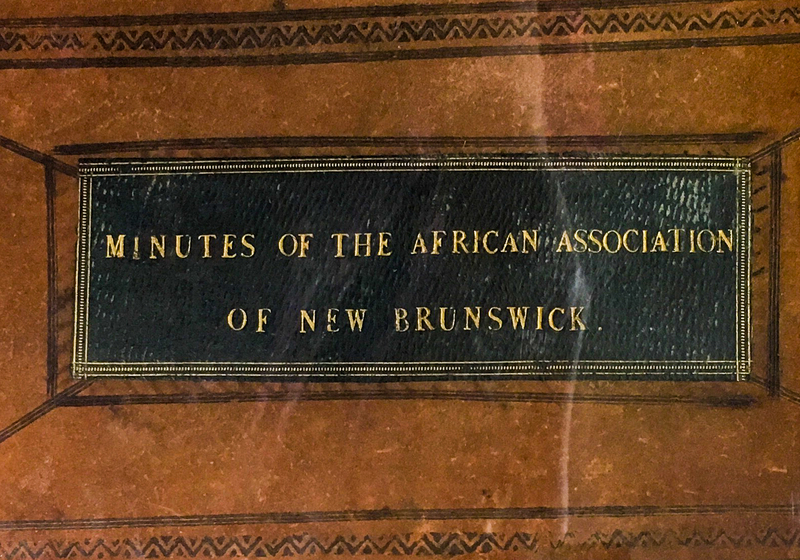
The African Association of New Brunswick was established in 1817 by free and enslaved people of color to gather and discuss education, religion, and racial uplift. The organization raised funds to establish a school for black children, the African School in New Brunswick. The organization was active for 7 years until 1824. This was the first organization established by people of African descent in New Brunswick, New Jersey.
Archival materials from the organization have been preserved at Special Collections and University Archives, Rutgers University Libraries, in the collection titled African Association of New Brunswick (N.J.). Minute Book, 1817-1824 (MC 50). The Scarlet and Black research team at Rutgers University has digitized and transcribed the minute book and permission slips from this collection. These sources have been integrated into the New Jersey Slavery Records database.
Minute book maintained by the Secretary of the African Association of New Brunswick from 1817 to 1824. This bound manuscript volume includes the constitution of the organization, meeting minutes, member rolls, and dues paid. The book contains copies of two speeches given by guests at the annual meetings of the association: the address delivered by the Rev. Jeremiah Gloucester of the Second African Presbyterian Church of Philadelphia, on January 1, 1820, and the address delivered by Gustavus V. Caesar, then a student at the Parsippany African School, on January 1, 1821. Additionally, a copy of a letter from Gustavus V. Caesar, read at a meeting of the association's standing committee on February 3, 1821, is in the minute book.
Related to the minute book are several permission slips from enslavers who allowed enslaved Black persons to join the organization. One permission slip is glued inside the book, and several loose permission slips are kept in an unmarked folder inside the same archival collection. Permission slips have been digitized as separate items in the New Jersey Slavery Records database and are listed under Linked Resources.
Ager was a Black girl born to an enslaved mother in the household of David Sheppard in Cumberland County. Her enslaver had properties in Bridgeton and Fairfield Township.
She was born in 1813, and her name was recorded as "Agur" on her birth certificate, and her mother was recorded as "Juno." Under New Jersey's gradual abolition law, she had the status of a slave for a term of 21 years, and then she would become eligible for emancipation. When David Sheppard died in 1827, his son Ercuries L. Sheppard inherited a person whose name was recorded as "Jane alias Ager Welsh." This is presumed to be the same girl.
Sussex County Births of Enslaved Children microfilm contains a birth record for Albert Francis Grove, son of Jane, enslaved by Mary Coursen of Hardwick township.
Albert P. Voorhees was an enslaver who resided in Somerset County, NJ, in the early 19th century. He lived around the area of Harlingen (in present-day Montgomery Township).
Albert Schenck was an enslaver who resided in Princeton, NJ, in the 18th century. A runaway advertisement for a Black man named Michael published in 1797 noted that Michael was "raised in Princeton in New Jersey, by Captain Albert Scank," using the phonetic spelling of the enslaver's name. The family name in the Princeton area is generally spelled Schenck.
The Historical Society of Princeton holds documents related to the Schenck family, including a land deed for Albert Schenck (100 acres at Stony Brook), which may be related to Michael's enslaver.
Alexander was a French-speaking Black man born around 1774 to 1776. He grew up in Saint Domingue (now Haiti). He was enslaved by Jacques Philipe Rossignol de Grandmont, a French planter who fled the island during the Haitian Revolution. Alexander was brought to Trenton, New Jersey, when Grandmont relocated there in the 1790s. In 1804, Alexander was living and working in the household of Andrew S. Hunter of Flemington, Hunterton County, likely hired out to Hunter by Grandmont. Alexander ran away from Hunter's house in July 1804 and was pursued by Hunter and Grandmont. Prior to Alexander's escape from Hunter's house, three other people ran away from Grandmont's household in Trenton, and it is possible that their escapes (or their assistance) influenced Alexander's decision to run away.
Alexander (also called Ellick) was born in 1805, the son of Elizabeth, enslaved by Jeremiah Manning of Piscataway, NJ. Under the provisions of New Jersey's Gradual Abolition Act of 1804, he was considered a slave for a term of 25 years and would become eligible for emancipation upon reaching that age. In 1806, his enslaver filed an abandonment certificate for Alexander, giving him up to the Overseers of the Poor of Piscataway.
Alexander was born in 1812, the child of Jane (enslaved by Austin D. Blackwell of Mapletown, NJ). Under the provisions of New Jersey's Gradual Abolition Act of 1804, he was considered a slave for a term of 25 years and would become eligible for emancipation upon reaching that age.
Alexander Dunn was a resident of Middlesex County, New Jersey. He served as the Justice of the Peace for the county in the early 19th century. In this official capacity, he issued manumission certificates for residents of Piscataway whose enslavers agreed to set them free.
Alexander Robinson was an enslaver who resided in Morristown, New Jersey, in the late 18th century. In a 1792 newspaper ad, he identified his residence as Belment Farm in Morristown.
Somerset County birth records of enslaved children contain a birth certificate for Alfred, born on 8 Nov 1807, son of Grace, enslaved by Dr. Jacob Scudder in Montgomery township.
Somerset County birth records of enslaved children contain a birth certificate for Alfred, child of Jude, born on 25 July 1818, enslaved by Peter Voorhees in Montgomery.
Alfred was born in 1832, the child of Caroline (enslaved by Robert Adrain of New Brunswick, NJ). Under the provisions of New Jersey's Gradual Abolition Act of 1804, he was considered a slave for a term of 25 years and would become eligible for emancipation upon reaching that age.
Alfred's mother died when he was a baby.
All was an enslaved man, born around 1787, who was manumitted by David Dunn of Piscataway, NJ. His certificate of manumission was issued on May 4, 1808. All was aged about 21 at the time of manumission.
Allen Reynolds was an enslaver who resided in Palmyra, Mississippi (present-day Davis Island). Removal certificates issued in Middlesex County, New Jersey, show that his associate Lewis Compton intended to bring a group of enslaved people from New Jersey to Allen Reynolds as part of a slave trading operation assisted by the legal machinations of Judge Jacob Van Wickle.
Allentown is a borough located in western Monmouth County, bordering Mercer County. Allentown was incorporated as a borough in 1889 from portions of Upper Freehold Township. The community has a long history as a village founded in the 18th century by Nathan Allan. It was originally known as Allen's Town or Allenstown.
Alpheus Freeman was an enslaver in New Brunswick, NJ. He was born in 1766, probably in Metuchen, NJ (which was part of Woodbridge Township at the time). He attended Queen's College (now Rutgers University), receiving his degree in 1788, after which he established a law practice in New Brunswick. He married Mary Parker in Philadelphia in 1803. He owned several properties in New Brunswick, including a large building on the corner of George Street and Prince (now Bayard) Street. He died suddenly on December 29, 1813, aged 47, and was interred with military and masonic honors. Archival documents show that he was the enslaver of a young man named Dick (who ran away) and a young woman who was sold by the executors of his estate to settle Freeman's accounts.
Ambo was a woman of African descent enslaved by John Neilson in New Brunswick, NJ. Her exact date of birth is unknown, but she was likely born in the 1790s.
She married an enslaved man named Mark Harris in 1811 and gave birth to four children between 1812 and 1818: Clara, Ann, Eliza, and Mark Jr. In 1822, Ambo was manumitted by John Neilson and became a free woman.
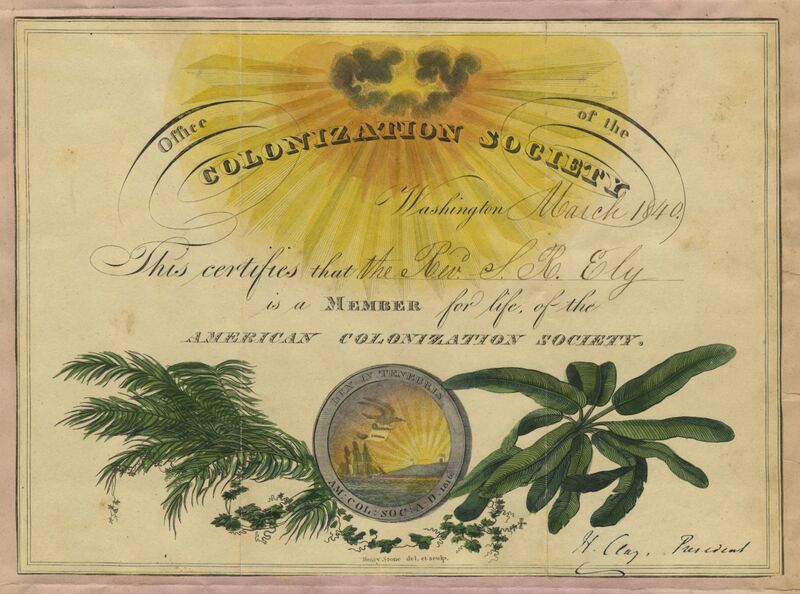
The American Colonization Society was established in 1816 for the purpose of encouraging and supporting the emigration of free African Americans to Africa. It was originally called the American Society for Colonizing the Free People of Colour of the United States, but came to be known as simply the American Colonization Society or ACS. The organization's founders believed that free Black people would never successfully integrate into American society as independent economic and political agents. One of the chief projects of ACS was the establishment of the colony of Liberia in West Africa as a destination for Black American emigrants.
This national organization was founded and sustained by prominent men from New Jersey and had particularly strong ties with the Princeton Theological Seminary and Princeton University (then called the College of New Jersey). Princeton-born Presbyterian minister named Robert Finley was the organization's chief founder.
In the twentieth century, ACS evolved to focus more on missionary and educational work in Liberia rather than emigration. The organization officially disbanded in 1964.
Amey was one of the victims of Jacob Van Wickle's slave trading ring in Middlesex County, New Jersey, in 1818. The legal documents related to the removal of Amey from the state of New Jersey to Louisiana suggest that she was born around 1796 and was aged 22 at the time of these events. However, Jacob Van Wickle falsified the age of some of his victims, making young children appear older than they really were and listing some children as adults in order to circumvent parental consent rules. For this reason, the birth year for Amey is questionable.
The New Jersey Society for Promoting the Abolition of Slavery enumerated enslaved people who lived in Evesham, Burlington County, around 1797. This person’s name appeared on the list. See the related Registration event for more information.
Amm's last name was not recorded, and the name of this person's enslaver was not recorded.
Amos Cooper was a white man who lived in Deptford, Gloucester County, New Jersey, in the early 19th century. He served as the Overseer of the Poor for Deptford and a Justice of the Peace for Gloucester County.
Amos Fithian was a white man who lived in Fairfield, Cumberland County, at the turn of the 19th century. He was the husband of Rachel Leake Fithian (and the cousin of Rachel's mother Hannah Fithian Leake), and he signed a document related to an enslaved woman who was part of the estate of Nathan Leake (his wife's deceased father).
Amwell was a township that existed in Hunterdon County, New Jersey, from 1708 to 1846. It was a large area of about 200 square miles that included the present-day East Amwell Township, West Amwell Township, Delaware Township, Raritan Township, Readington Township, and portions of Clinton, Lebanon, and Tewksbury Townships.
Amy was a Black woman enslaved by Joshua D. Austin of Sussex County, NJ, in the early 19th century. She was married to a Black man named Dr. Edward Cook. They had at least two children together, Rosannah and Mary.
Amy West née English was the daughter of Mercy English of Burlington, New Jersey. The English were a Quaker family. Amy's husband was George West. Amy inherited property after her mother's death in 1820, including a bound woman named Fanny Pursue. Along with her siblings, Amy was party to a transaction whereby Mercy English's heirs sold Fanny Pursue to Rowland Jones for a nominal price, with the explicit instructions that Rowland Jones should manumit Fanny and set her free.
Amy (or Amey) Cheston née Walker was an enslaver who resided in Stony Brook, in the vicinity of Princeton, New Jersey, in the early 19th century. She was the widow of John Cheston.
Andrew Bray was an enslaver who lived in Hunterdon County, NJ, in the early 19th century. His exact place of residence is unclear from the historical records. Several men known as Andrew Bray lived in Hunterdon County at that time, all grandsons and great-grandsons of the Baptist minister Rev. John Bray. The Bray family was associated with Kingwood, Locktown, and Lebanon localities in Hunterdon County, and primarily engaged in farming.
Andrew Brown was an enslaver who resided in Franklin Township, Somerset County, New Jersey, in the early 19th century. He served as the Overseer of the Poor of Franklin and also as a Justice of the Peace for the county.
Andrew Elston was a resident of Middlesex County, New Jersey. He served as the Justice of the Peace for the county in the early 19th century. In this official capacity, he issued manumission certificates for residents of Woodbridge whose enslavers agreed to set them free.
Andrew Jenkins was a white man who lived in Newton Township, Gloucester County (now Camden and the surround area in Camden County), in the early 19th century. He served as the Overseer of the Poor for the township.
Andrew Kirkpatrick (1756-1831) was a prominent New Brunswick lawyer and politician with deep ties to Queen's College (later Rutgers University). He enslaved multiple people in his household. In the first two decades of the 19th century, he manumitted several individuals.
Andrew Kirkpatrick was born in the area of Mine Brook in Bernards Township, Somerset County, and his family was associated with the Presbyterian Church in Basking Ridge. He graduated from the College of New Jersey (now Princeton University) in 1775. In the 1780s, Andrew Kirkpatrick was a teacher at the Queen's College grammar school. In 1783, he was the first person to receive an honorary degree from Queen's College. In 1797 be became a member of the New Jersey General Assembly, and a year later he was appointed as a judge to the New Jersey Supreme Court. He served as the Chief Justice of the New Jersey Supreme Court from 1804 to 1825.
Andrew Kirkpatrick served as a trustee of Queen's College from 1792 to 1809. During his time as a trustee, he was instrumental in reviving the struggling college. He worked with the Reverend Ira Condict to raise funds for the erection of a new building for the college (now called Old Queens building). Andrew Kirkpatrick then sent his son John Bayard Kirkpatrick to study at the college in the 1810s.
Andrew Kirkpatrick's oldest son Littleton Kirkpatrick carried on his father's legacy in supporting the college; he served as a trustee of the college from 1841 until his death in 1859. Having no surviving heirs when they died, Littleton Kirkpatrick and his wife Sophia Astley Kirkpatrick left their fortune to the college. Their donation was used to build the Kirkpatrick Chapel on campus.
Andrew McDowell was a resident of Middlesex County, New Jersey. He served as the Justice of the Peace for the county and the Overseer of the Poor of South Brunswick in the early 19th century. In this official capacity, he issued manumission certificates for residents of South Brunswick whose enslavers agreed to set them free.
Middlesex County records indicate that Andrew McDowell was an enslaver.
The New Jersey Society for Promoting the Abolition of Slavery enumerated free Black people who lived in Evesham, Burlington County, around 1797. This person’s name appeared on the list. See the related Registration event for more information.
According to the report, he had 8 people in his family and property worth $300.
Andrew Rowan was a resident of Middlesex County, New Jersey. He served as the Justice of the Peace for the county in the early 19th century. In this official capacity, he issued manumission certificates for residents of East Windsor and West Windsor whose enslavers agreed to set them free.
Andrew S. Hunter was an enslaver who resided in Flemington, New Jersey, in the early 19th century. He had a connection with Jacques Philipe Rossignol de Grandmont, an exiled Haitian planter who relocated to New Jersey. Some of the enslaved people that Jacques Philipe Rossignol de Grandmont brought from Haiti worked in Hunter's household.
The New Jersey Society for Promoting the Abolition of Slavery enumerated black people (free and enslaved) who lived in Springfield and New Hanover townships, Burlington County, around 1797. This person’s name appeared on the list. The report did not specify whether this person lived in Springfield or in New Hanover. See the related Registration event for more information about the report.
He was listed as a "lad," indicating that he was a young man at this time.
Ann was a Black woman who lived in Somerset County, New Jersey, in the early 19th century. She was enslaved by Jacob Van Doren of Bedminster. A birth certificate for her child has been found among Somerset County records.
Ann was an enslaved woman, born around 1799, who was manumitted by Henry Cotheal and David Cotheal both of Woodbridge, NJ. The certificate of manumission was issued on November 20, 1823. The deed of manumission was executed on the same day, signed jointly by Henry Cotheal and David Cotheal. Ann was aged 24 at the time of manumission.
Ann was a girl of African descent and the daughter of Flora, born circa 1780s. In January 1787, Flora's enslaver Anthony L. Bleecker of New York City sold Flora together with her daughters Phillis and Ann to John Neilson of New Brunswick, NJ. Ann's age at the time of this sale is not known.
Ann Hopkinson née Borden was the daughter of Colonel Joseph Borden (1719–1791) and Elizabeth Rogers of Bordentown, Burlington County, New Jersey. The family was among the prominent founders of Bordentown, which is named for Ann's grandfather Joseph Borden, the elder.
Ann married Philadelphia attorney Francis Hopkinson. In the 1770s, they lived in Bordentown, and Francis Hopkinson became a New Jersey delegate to the Second Continental Congress and a signer of the Declaration of Independence. Ann's husband returned to professional life in Philadelphia in 1777, but the family continued to maintain a residence and small farm in Bordentown. The house is now on the National Register of Historic Places, known as Francis Hopkinson House, located at 101 Farnsworth Avenue in Bordentown.
Ann and Francis had at least two enslaved people in their household, named Dan and Violet.
Ann Finley née Clarkson was the second wife of the Rev. Samuel Finley, president of Princeton University (then called the College of New Jersey). She married Samuel Finley in 1761 and lived with him at the President's House on campus, where the family had several enslaved people in the household in the 1760s.
Ann Coburn (or Cobourn) was a white woman who lived in Kent County, Maryland, in the late 18th century. A manumission document whereby she freed a man named Joe in 1798 was found among Gloucester County records in New Jersey. It is not clear from the document transcript why it was filed in Gloucester County.
Ann Henderson was an enslaver who resided in Alexandria, Hunterdon County, NJ, in the early 19th century. She died circa 1805, and her will (written in 1802) required that her estate should be sold off and proceeds divided among her heirs. There was at least one enslaved Black woman in her household at the time of her death, whose name has not been confirmed.
Ann Henderson was the widow of Nathaniel Coleman, who died circa 1756, and widow of James Henderson, who died in circa 1792.
Ann was a woman of African descent who was born in New Brunswick, NJ, on June 23, 1814, to parents Ambo and Mark Harris Sr. Ann's parents were both enslaved at the time of her birth, but Ambo would eventually become free when enslaver John Neilson manumitted her.
Ann's birth was reported to the Middlesex County Clerk by enslaver John Neilson, who was the legal owner of her mother Ambo. Under New Jersey's gradual abolition law, Ann was considered a "slave for a term" of 21 years, and she was bound to serve John Neilson and his heirs until the year 1835 when she would become eligible for emancipation.
Ann was the second child of Ambo and Mark Harris Sr. Her older sister was Clara, and her younger siblings were Eliza and Mark Jr.
Ann Berrien (née Hepburn) was the wife of Samuel Berrien (c. 1766-1830) of East Windsor, NJ. Jointly with her husband, she manumitted a woman named Martha Richards in 1805.
Middlesex County records contain several birth certificates and manumission certificates for an enslaver named Ann Parker, who was listed as a widow and dowager in the 1810s, residing in the City of New Brunswick within North Brunswick Township. These county records likely refer to Ann Parker née Lawrence (daughter of John Lawrence), the wife of John Parker (1763–1801). By marriage to John Parker, she was related to the prominent Parker family of Perth Amboy: she was the sister-in-law of U.S. Congressman and Rutgers University benefactor James Parker Jr. (1776-1868), and the daughter-in-law of James Parker Sr. (1725–1797) and Gertrude Parker née Skinner (1739-1811).
Somerset County records contain three records related to enslaver Ann Frelinghuysen dated between 1812 and 1822. This appears to refer to Ann Frelinghuysen née Yard, the second wife of Frederick Frelinghuysen (1753-1804), who would have been a widow by the time these records were submitted and thus would sign them in her own name. Her husband was a U.S. Senator and an early affiliate of Queen's College (now Rutgers University).