Anna Manning was an enslaver who resided in Piscataway in the early 19th century. She was the wife of William Manning. The Mannings had at least 8 enslaved people in their household in 1814 (as enumerated in the will of William Manning who died that year).
Anne Hart (née Sealey) was an enslaver who resided in Hopewell, Hunterdon County (in present-day Mercer County), New Jersey, in the late 18th century. She was the second wife of the Rev. Oliver Hart (1723-1795). She was from South Carolina and was the widow of Charles Grimball of Charleston. She married Oliver Hart in 1774 while he was serving as a pastor in Charleston. She then moved with him to New Jersey after he accepted a call to become the pastor of the Baptist Church in Hopewell in 1780.
The Harts brought at least one enslaved boy with them from South Carolina to New Jersey in 1780. The boy's name was Friday. Shortly after her husband's death in 1795, Anne Hart sold two Black boys, named James and Will, to other enslavers in the area, with the stipulation that the boys would be freed at age 25. She then moved back to South Carolina.
Annis Boudinot Stockton (1736-1801) was the daughter of Huguenot silversmith Elias Boudinot III and Catherine Williams. Her father worked as Postmaster and kept a tavern on Nassau Street. Annis married Richard Stockton late around 1757. Annis was a poet. Upon her husband’s death, Annis turned Morven over to her son, Richard “the Duke” Stockton and his wife, Mary Field Stockton.
This biographical note was adapted from the Morven Museum and Garden permanent exhibit text.
Anthony (also called Tony or Toney) was an enslaved man, born around 1789, who was manumitted by Sarah Voorhees of the City of New Brunswick in North Brunswick Township, Middlesex County, New Jersey. The certificate of manumission was issued on July 12, 1819. The deed of manumission was executed on the same day. Anthony was aged 30 at the time of manumission.
Anthony was born on September 29, 1804, and was enslaved by Joseph W. Hagaman of Princeton, NJ. Under New Jersey's gradual abolition law, he had the status of a slave for a term of 25 years. This meant he was bound to serve his enslaver until age 25, and then he would become eligible for emancipation. In 1812, Joseph W. Hagaman moved from the state of New Jersey to Cincinnati, Ohio, and took Anthony with him. The removal certificate related to this move stated that Anthony had no parents residing in New Jersey.
Somerset County birth records of enslaved children contain a birth certificate for Anthony, son of Phillis, born on 25 Mar 1806, enslaved by Richard Stockton, the owner of Morven mansion in Princeton.
Somerset County birth records of enslaved children contain a birth certificate for Anthony, son of Phillis, born on 12 Jul 1813, enslaved by the Rev. Robert Finley of the Presbyterian Church in Basking Ridge, Bernards township.
Somerset County birth records of enslaved children contain a birth certificate for Anthony, born on 15 Jun 1816, enslaved by John P. Dumont in Hillsborough.
Anthony Lispenard Bleecker was a shipping merchant and real estate auctioneer in New York City. He served as a major during the Revolutionary War, and his family lived in New Jersey while the British troops occupied New York City during the war. He was one of the wealthiest and most powerful real estate and stock brokers in New York City in the late 18th century. Bleecker Street in Manhattan is named for him.
In 1787, he sold an enslaved woman named Flora and her daughters Ann and Phillis to John Neilson, an early trustee and benefactor of Queen's College (later Rutgers University).
The New Jersey Society for Promoting the Abolition of Slavery enumerated free Black people who lived in Evesham, Burlington County, around 1797. This person’s name appeared on the list. See the related Registration event for more information.
The New Jersey Society for Promoting the Abolition of Slavery enumerated black people (free and enslaved) who lived in Northampton, Burlington County, around 1797. This person’s name appeared on the list. See the related Registration event for more information.
Anthony Peron and a wife and held property worth 200 dollars.
Antony was an enslaved man, born around 1786, who was manumitted by Aaron Hassert of New Brunswick, NJ. The certificate of manumission was issued on December 18, 1823. The deed of manumission was executed on the same day. Antony was aged 37 at the time of manumission.
Appollo Woodward was an enslaver who resided in Upper Freehold Township, Monmouth County, NJ, in the early 19th century. He identified his residence as being "near Arney's Town."
Somerset County birth records of enslaved children contain a birth certificate for Arch, son of Jenny and Tom, born on 28 January 1812. Arch and his family were enslaved by John Frelinghuysen. The historic property where Arch and his family lived has been preserved and is known as the General John Frelinghuysen House in the present-day borough of Raritan (formerly part of Bridgewater township).
Archibald Read was the son of the Rev. Israel Read. He grew up in the 18th century in Bound Brook, NJ, where his father was the pastor of the Presbyterian Church for many years. He and his brother Thomas inherited a man named Tony from the pastor's estate and sold Tony several years later in 1798. The sale took place in New Brunswick, NJ, but Archibald did not personally appear to sign the sale documents. He may have moved away from the area by this time.
His family name is variously spelled Read or Reed in historical documents.
Arietta Smock was an enslaver who resided in North Brunswick, New Jersey, in the early 19th century. She passed away circa 1814, and by her last will and testament she set free a Black woman named Betty.
Arneytown (or Arney's Town) is a historical community located in Upper Freehold township, Monmouth County, at the border with North Hanover township, Burlington County.
The New Jersey Society for Promoting the Abolition of Slavery counted the number of free Black people who lived in Chester Township, Burlington County, in 1797. This person's name appeared on the list.
Asa Runyon was a resident of Middlesex County, New Jersey. He served as the Judge of Common Pleas for the county in the early 19th century. In this official capacity, he issued manumission certificates for residents of North Brunswick whose enslavers agreed to set them free.
Asbury is a historic community located on the Musconetcong River in Franklin Township, Warren County (and partly in Bethlehem Township, Hunterdon County). Asbury was settled primarily in the mid-18th century, when all of present-day Warren County was still part of Sussex County. Some documents related to slavery in Asbury can be located among Sussex County records.
Not to be confused with Asbury Park in Monmouth County.
Asher Applegate was an enslaver who resided in East Windsor, NJ. He wrote his last will and testament in 1832, two years before his death. The will has been transcribed by The Applegate Project. Asher Applegate did not mention enslaved people in his will. Aside from a piece of land in Hightstown, Asher Applegate left all the residue of his estate to his wife Sarah Applegate (who outlived him by about a year and a half). This would include the enslaved persons in the Applegate household, including Jane and her children Francis, Jude, and Tabitha. Asher Applegate's son Abijah Applegate was one of the executors of the estate and handled affairs related to the enslaved people, including reporting the births of Jane's children to the Middlesex County Clerk.
Asher Pyatt of Piscataway co-executor of the will of Ephraim Pyatt (together with Reuben Drake), and he manumitted a man named Thomas on behalf of the estate of Ephraim Pyatt.
Atlantic County was formed from a portion of Gloucester County in 1837. Mays Landing in Hamilton Township serves as the county seat.
The earliest municipalities that formed in this area during the colonial era were Egg Harbor and Galloway. These existed when the area was part of Gloucester County. See Gloucester County to learn more about the demographics of this area during the slavery era and to see related events and people.
Augustus was one of the victims of Jacob Van Wickle's slave trading ring in Middlesex County, New Jersey, in 1818. The legal documents related to the removal of Augustus from the state of New Jersey suggest that he was born around 1814 and was aged 4 when he was forced to leave New Jersey for Pointe Coupee Parish, Louisiana, together with his mother Hager and his siblings Mary and Roda. Note that disembarkation records in New Orleans recorded the name of Hager's son as "Charles" instead of Augustus. It is unclear whether Charles was an alternative name for the boy or merely a recording error made by the customs officials in New Orleans.
Under New Jersey's gradual abolition law, Augustus had the status of a slave for a term of 25 years. This meant he was bound to serve his enslaver until age 25, and then he would become eligible for emancipation. His right to emancipation at age 25 was recorded by the judges who authorized his removal from New Jersey at age 4. However, going to Louisiana as a child effectively deprived him of the opportunity to gain freedom because enforcing his legal rights under New Jersey law would be nearly impossible in Louisiana.
Augustus R. Taylor was an enslaver who resided in the City of New Brunswick. In the early decades of the 19th century, he lived on the west side of the city, which was at that time part of Franklin Township, Somerset County (but is now part of Middlesex County). Consequently, he filed some documents related to enslaved people with the Somerset County Clerk's Office.
Austin Davis Blackwell was an enslaver who resided in Mapletown in South Brunswick Township, NJ. He was the son of Thomas Blackwell (1741-1825) and Bathsheba Davis Blackwell. He signed a manumission deed for a Black man named Samuel in 1824 as an agent on his father's behalf. Additionally, in 1830, several years after his father's death, Austin reported to the Middlesex County Clerk that a Black woman named Jane had given birth to 6 children between 1809 and 1817 in the Blackwell household. From these birth records, it can be inferred that Jane and her children were enslaved by Thomas Blackwell during Thomas's lifetime and then by Austin Davis Blackwell after 1825.
Azor was a French-speaking Black man born circa 1763. He grew up in Saint Domingue (now Haiti). He was enslaved by Jacques Philipe Rossignol de Grandmont, a French planter who fled the island during the Haitian Revolution. Azor was brought to Trenton, New Jersey, when Grandmont relocated there in the 1790s. Azor was one of the people who ran away from Grandmont in 1804.
Somerset County records have two conflicting birth certificates for Baas, son of Merriam, enslaved by Andrew Howell of Bridgewater. One certificate says he was born on 16 January 1818, and the second certificate says he was born a month later on 16 February 1818.
Bainbridge House is an 18th-century historic house located at 158 Nassau Street in Princeton, New Jersey. The house is owned by Princeton University (since 1877). Bainbridge House served for a long time as the home of the Historical Society of Princeton, and it is now operated by the Princeton University Art Museum.
Several enslaved persons are known to have lived at the house in the 18th century. The house was originally built in 1766 for a tanner named John Stockton (1734-1771). When Stockton died in 1771, the inventory of his estate showed that an enslaved man named Peter lived in the household.
After John Stockton's death, his heirs rented out the house to Dr. Absalom Bainbridge and his wife Mary. While Absalom Bainbridge lived at this house, he enslaved a man named Prime. Prime eventually attained freedom for his service during the Revolutionary War. Extensive information about Prime and his long quest for freedom is available with digitized archival sources. See the illustrated essay by Izzy Kasdin for the Princeton & Slavery Project, which draws on Giles R. Wright and Gloria Halpern's 1991 article in the Princeton History (the journal of the Historical Society of Princeton).
Baltimore is the most populous city in the state of Maryland. It was founded in 1729. Baltimore is an independent city (it exists outside of the jurisdiction of any county). Prior to 1851, Baltimore was the seat of the surrounding Baltimore County.
Page listing the baptisms of Rachel and her children in 1756, from the Christ Episcopal Church Shrewsbury Parish Register for the Colonial era.
The name Robert is inserted in an unusual manner in the date column on the left side of the page, on the same line as the name Johnson. The insertion of the name "Robert" in the date column is not entirely clear in its intent. It is possible that "Robert Johnson" was the full name of the child listed on that line or, alternatively, Robert may have been another (fifth) child of Rachel who was baptized that day.
Baptistown is an unincorporated historical community located in Kingwood township, Hunterdon County, New Jersey. The village of Baptistown was established in Hunterdon County in mid-18th century during the colonial era.
Barbados is an island country in the Caribbean region. It was historically part of the British West Indies and was a leading exporter of sugar since the colonial era. Its early development was wholly dependent on slave labor and the plantation economy.
A significant number of early English settlers in New Jersey were plantation owners who relocated from Barbados to New Jersey in the late 17th century. These planters brought large groups of enslaved people with them from Barbados.
Bridgetown, Barbados, was a major slave trading port where captives arriving from Africa often landed first before being taken to other Caribbean islands or up to North America. For this reason, throughout the 18th century, many people of African descent arrived in New Jersey via Barbados.
Barbarroux Wharf was one of the two main wharves located in Burlington, New Jersey, at the turn of the 19th century. It was located at the foot of Talbot Street. A shipyard was established here as early as 1698, and vessels sailed from here to all parts of the world throughout the 18th century.
The wharf became known as Barbarroux Wharf in the 1790s, after a wealthy Frenchman named Jean Andre Barbarroux moved to Burlington and acquired the property along the riverfront. His home was near the wharf. Barbarroux was the owner of several large coffee plantations in Saint-Domingue (now Haiti), where he exploited slave labor extensively. During the slave revolt that turned into the Haitian Revolution, Barbarroux and his family fled to New Jersey and settled in Burlington. He brought with him several enslaved people from Saint-Domingue, and these people may have worked on the Barbarroux Wharf.
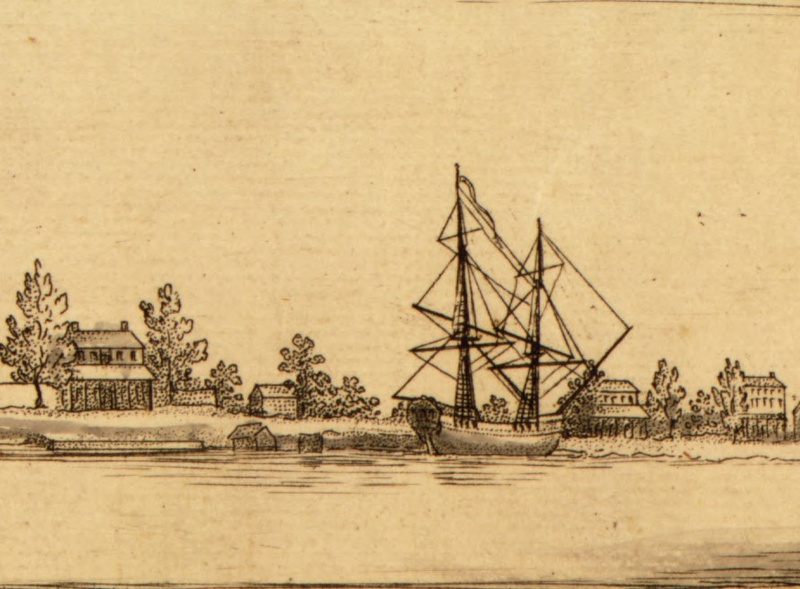
A 1797 map, called "A Plan of the Island of Burlington and a View of the City from the River Delaware," by W. Birch, displays the location of Barbarroux Wharf and includes an image of a vessel docked there.
Barnt DeKlyn was an enslaver who was born in Boston. He moved to New York in the 1760s and subsequently moved to the Trenton area in the 1780s.
DeKlyn acquired his wealth by trading textiles to the Continental Army during the American Revolution. In the 1780s, DeKlyn bought land along the Delaware River outside of Trenton. He is known for building a mansion called Bow Hill, which is on the National Register of Historic Places in present-day Hamilton Township, Mercer County. The mansion was built in 1790 and was a site of enslavement well into the 19th century. The Black woman named Tine, who ran away from DeKlyn in 1818, likely lived and worked at Bow Hill prior to her escape.
The Barron Estate was the home of the Barron family in Woodbridge, New Jersey, located near the First Presbyterian Church. The estate included the historical Barron House, located at 574 Rahway Avenue, which was built in 1803 for Joseph Barron, deacon of the First Presbyterian Church.
Several historical markers were erected by the Woodbridge Township Historic Preservation Commission on the property.
The following is the text of the Barron House historical marker:
"Home of Deacon Joseph Barron,
First Presbyterian Church.
One of many handsome colonial homes, it
remained in the Barron family, donors
of the money and land to build the
Barron Library
Circa 1803"
The following is the text of the Barron Estate historical marker:
"The Barron name is an important one in Woodbridge, as the family was one of the first to settle here in the late 17th century. The Barron family, noted patriots and philanthropists, made many contributions to the town. The Barron estate encompassed the land opposite First Presbyterian Church and continued west onto the property through which Barron Avenue runs. Two of the original structures built by the Barron family still stand: the Barron House and the Barron Library.
The Barron House at 574 Rahway Avenue was built in 1803 by Joseph Barron, a deacon of First Presbyterian Church, and his sons, John and Thomas. John managed a farm on the family estate and established a cabinet factory in Woodbridge. Thomas Barron held a partnership in a trading house in the West Indies trade. Upon his death, he bequeathed $50,000 for the establishment of a library.
The Barron Library at 582 Rahway Avenue was built in 1877 on land donated from the family estate by Thomas’ nephew, Civil War physician John C. Barron. It was the first free public library in Middlesex County. Constructed by renowned architect J. Clevland Cady in beautiful Romanesque Revival-style, the building is a supreme example of Victorian-era architecture and is listed on both the State and National Register of Historic Places. Since 1977 it has housed the Barron Arts Center.
More information visit www.wthpc.org Woodbridge Township Historic Preservation Commission."
Basking Ridge is an unincorporated historical community located in Bernards Township, Somerset County, New Jersey. The village of Basking Ridge was settled by Presbyterians in the early 18th century, and the Basking Ridge Presbyterian Church (established 1717) was the central institution in the community.
Bedminster is a township in Somerset County, New Jersey, located in the northwest part of the county and bordering Morris and Hunterdon counties. It was formed by Royal charter in 1749 from a portion of the Somerset County's Northern Precinct. It originally included also the present-day Peapack-Gladstone borough, until that borough broke off in 1912.
Bek (or, possibly, Bel) was a Black woman who lived in Bridgewater, Somerset County, New Jersey, in the early 19th century. She was enslaved by Abraham Van Arsdalen. A birth certificate for her child has been found among Somerset County records.
Bell was a Black woman who was enslaved by William Livingston (New Jersey's first governor after the Revolution and namesake of Livingston College at Rutgers University). She lived with the Livingston family in Elizabeth, New Jersey. Bell gained freedom in October 1787 when William Livingston manumitted her together with her son Lambert. The manumission document mentioned that she was born in the Livingston family "in a state of slavery." She was most likely born in New York State where Livingston lived until 1772 before he moved to Elizabeth.
Belle Vue was a 300-acre farm owned by George Farmer on the Raritan River opposite New Brunswick in the early 19th century. The area was, at that time, part of Piscataway. The location of Belle Vue is estimated to be in present-day Highland Park.
Ben was an enslaved man who lived in New Jersey in the early 19th century and was manumitted by Joseph Grover of South Brunswick, NJ. The certificate of manumission was issued on April 15, 1820. The deed of manumission was executed on the same day. Ben was aged 21 to 40 at the time of manumission.
Ben was a man of African descent born circa 1787. He was enslaved by Elijah Blackwell of Princeton, NJ, and evidently, there was an agreement that Ben would serve Blackwell until spring 1822 (when Ben would be about 35 years old). In November 1811, Ben ran away from Blackwell together with a young Black man named Aaron and a white woman (whose name is not known) and the woman's child (who was described by Blackwell as a "mulatto child"). The runaway ad published by Elijah Blackwell described Ben as "a mulatto, rather white" and a "great professor of religion."
Ben was born in 1805, the child of Cate (enslaved by Richard Field of Piscataway, NJ). Under the provisions of New Jersey's Gradual Abolition Act of 1804, he was considered a slave for a term of 25 years and would become eligible for emancipation upon reaching that age.
Ben was a young Black man who lived at Three Mile Run near New Brunswick and was enslaved by Leffert Waldron in the mid-18th century. He was born circa 1750. In 1769, he ran away together with another young Black man named Jack.
Ben was born around 1799 and was enslaved by James Smith of Middlesex County, NJ. In 1817, James Smith sold Ben to a man named Jacob Klady who took Ben away from New Jersey to Klady's plantation in Ouachita Parish, Louisiana. Ben was 18 years old at this time.
Benajah Mundy was a resident of Middlesex County, New Jersey. He served as the Justice of the Peace for the county in the early 19th century. In this official capacity, he issued manumission certificates for residents of Woodbridge whose enslavers agreed to set them free.
Captain Benajah Osmun was a Revolutionary War veteran originally from Hunterdon County, New Jersey. After the war, he worked as the overseer managing the Black labor force for General David Forman, who had an estate in the area of present-day Manalapan (then part of Freehold), Monmouth County, New Jersey. In 1789, Osmun was principally responsible for securing the convoy that took over 60 people from Forman's estate in Monmouth County to Natchez, Mississippi, where David Forman and his brother Ezekiel Forman aimed to establish a tobacco plantation. He settled in Natchez and died there in 1815.
Benjamin was an enslaved man who lived in New Jersey in the early 19th century and was manumitted by James Randolph of Piscataway, NJ. The certificate of manumission was issued on April 8, 1816. The deed of manumission was executed on the same day. Benjamin was aged 21 to 40 at the time of manumission.
The New Jersey Society for Promoting the Abolition of Slavery enumerated black people (free and enslaved) who lived in Springfield and New Hanover townships, Burlington County, around 1797. This person’s name appeared on the list. The report did not specify whether this person lived in Springfield or in New Hanover. See the related Registration event for more information about the report.
He was listed as a householder with 3 people in his family.
The New Jersey Society for Promoting the Abolition of Slavery enumerated free Black people who lived in Evesham, Burlington County, around 1797. This person’s name appeared on the list. See the related Registration event for more information.
According to the report, he had 4 people in his family.
Benjamin was an enslaved man, born around 1794, who was manumitted by Robert Boggs of North Brunswick, NJ. The certificate of manumission was issued on July 27, 1822. The deed of manumission was executed on the same day. Benjamin was aged 28 at the time of manumission.
Benjamin Burrough was a white man who lived in Gloucester County, New Jersey, in the early 19th century. He served as a Justice of the Peace for the county and, in that official capacity, signed manumission documents in Newton.
Benjamin Cooper was the son of Samuel Cooper, who owned and operated a ferry at Cooper's Poynt in Newton Township, Gloucester County (present-day Camden in Camden County). He is mentioned in the exhibit "Enslaved Africans of Pomona Hall" at the Camden County Historical Society.
Benjamin Cooper was an 18th-century ferry operator in the area that is now the City of Camden. Benjamin's family was in the ferry business in the area since the 1690s, transporting people and goods across the Delaware River to Philadelphia. Benjamin's cousin William Cooper (1694-1767) operated the older ferry that went from the foot of present-day Cooper Street to Arch Street in Philadelphia. Benjamin was in charge of the second ferry terminal, which was located at Cooper's Poynt, north of the old ferry. He operated this ferry terminal from about 1728 until about 1762.
From 1762 to 1764, Benjamin Cooper leased the ferry operation to a Philadelphia man named Roberts. Thus, during that brief period in the 1760s, historical records refer to this terminal as "Roberts' Ferry." Slave trafficking activities at this ferry terminal peaked during Roberts's tenure. In 1765, the Cooper family took control of the ferry again, and Benjamin Cooper's son, Samuel Cooper, soon became the primary operator.
The New Jersey Society for Promoting the Abolition of Slavery enumerated black people (free and enslaved) who lived in Northampton, Burlington County, around 1797. This person’s name appeared on the list. See the related Registration event for more information.
Benjamin Franks had a wife and was listed as industrious with property worth 20 dollars.
Benjamin Griggs was an enslaver who lived in Cranbury, Middlesex County, New Jersey, in the late 18th and early 19th centuries. A Black man named Tone ran away from his household in the summer of 1810.
Benjamin Griggs acted as one of the administrators of the estate of Vincent Wetherill of Cranbury (together with co-administrator Sarah Wetherill). He sold several enslaved people for the Wetherill estate in 1810.
Benjamin James was a Black man born around 1782. He grew up in slavery and was manumitted by enslaver Samuel Eli (or Ely) of East Windsor, NJ, on April 17, 1807. Benjamin James was aged 25 at the time of manumission.
On June 10, 1820, when Benjamin James was about 38 years old, he manumitted an adult Black man named George Wiles. This 1820 manumission certificate listed the enslaver as "Ben James blackman of the township of East Windsor." This is one of two manumissions recorded in Middlesex County where the enslaver performing the manumission is a Black person. It is possible that Benjamin James and George Wiles may have been related. African Americans in the early 19th century sometimes purchased and then manumitted their own family members as a way to secure freedom for their relatives. It is uncertain whether a familial relationship existed between Benjamin James and George Wiles.
Benjamin Marsh lived in Falls, Bucks County, Pennsylvania, in the 1810s.
He was the son of John Marsh of Woodbridge, New Jersey. Benjamin inherited ownership of an enslaved man named Peter Furman from his late father. Benjamin proceeded to manumit Peter Furman in Woodbridge in 1814.
Benjamin Mendes was an enslaved man, born around 1784, who was manumitted by Benjamin Davids of Woodbridge, NJ. The certificate of manumission was issued on March 19, 1819. The deed of manumission was executed on March 17, 1819. Benjamin Mendes was aged 35 at the time of manumission.
Benjamin Taylor was a marine captain who resided in New Brunswick, NJ, in the 1810s. Taylor was the enslaver of a man named Mark Harris. Taylor sold Mark Harris to James Neilson in 1816.
Benjamin Vincent was an enslaver who resided in Paterson, New Jersey, at the turn of the 19th century. He was the owner of the Paterson Stage, a stagecoach company that transported passengers from Paterson to Jersey City and other places in northern New Jersey. He also operated a tavern in Paterson. Additionally, while he resided in Paterson, he was also the owner of a farm in the area of Pequannock, Morris County. By the 1810s, he was residing in Jersey City.