Bergen County is located in Northern New Jersey across the Hudson River from New York City. Hackensack serves as the county seat. During the slavery era, Bergen County was larger than it is today and included the entire area of present-day Hudson County and a portion of present-day Passaic County (those areas separated from Bergen County in the mid-19th century). Bergen was the stronghold of slavery in New Jersey.
County demographics from the 1800 U.S. census, when slavery in New Jersey reached its peak:
In 1800, Bergen County had the highest figures in all categories related to Black people and enslavement: the largest Black population (3,027), highest percentage of Black residents (20%, i.e. 1 in 5 residents were Black), largest number of enslaved persons (2,825), highest enslaved population percentage (18.6% of the total population), and highest rate of enslavement for Black residents (93.3% of Black residents living in slavery). Bergen had 202 free Black residents (6.7% of the Black population or 1.3% of the total population of the county). The total population of the county was 15,156, ranking 9th among New Jersey's 13 counties by population.
The original Bergen County courthouse was built in 1715 in the village of Hackensack (now the City of Hackensack). Since that time, Hackensack has served as the county seat almost continuously, with the exception of several years during the Revolutionary War when the court had to move after the British troops burned down the courthouse. The original courthouse (and its successors) included a jail. Black people captured as suspected runaways were held at the county jail in the 18th and 19th centuries.
Bergen Township was a historical township that existed on the west bank of the Hudson River in northern New Jersey from the colonial era until the Civil War. This township broke up into smaller municipalities in the 19th century and no longer exists.
Many records from the slavery era mention Bergen Township. Most (though not all) of these early records are referring to the area that is now part of modern Jersey City.
Bergen Township was formed in Dutch colonial New Netherland in 1661, three years before the colony was taken over by the English and became New Jersey. Originally, when Bergen Township was formed, it encompassed within its boundaries all of the area of present-day Hudson County that lies between the Hudson River and the Hackensack River (i.e., all of modern Hudson County except Kearny and Harrison). The township shared the name with the surrounding county, because this area was then part of Bergen County, and the modern Hudson County did not yet exist.
In the 19th century, Bergen Township broke up into Jersey City, Bayonne, North Bergen, and several other small municipalities along the Hudson River. In 1840, the area of the historical Bergen Township broke off from Bergen County to form the new Hudson County. Bergen Township ceased to exist in 1862.
Bernards is a township in the northern part of Somerset County, New Jersey. It was formed in 1760 from a portion of Somerset County's Northern Precinct. It was originally known as Bernardston in the 18th century. The name was officially changed to Bernards in 1798. The original territory of the township was larger than it is today. A large portion of Bernards was taken in 1806 to form Warren township. Additionally, in 20th century, the municipalities of Far Hills and Bernardsville broke off from Bernards township. Thus, slavery-era records that mention Bernards or Bernardston may be referring to locations in present-day Warren, Far Hills, or Bernardsville.
Bernardsville is a borough in the northernmost section of Somerset County, New Jersey. Historically, during the slavery era, this area was part of Bernards township. Bernardsville did not exist as a separate municipality until it broke off from Bernards township in 1924. Records related to slavery in the area usually list Bernards township as the locality. Additionally, researchers are encouraged to review records attached to Mine Brook, which is a historical name associated with the southern part of modern Bernardsville near Basking Ridge.
Berten was a Black person who lived in Gloucestertown in the late 18th century and was enslaved by Joseph Hugg. Gloucester County records indicate that Berten was manumitted and released from slavery in 1788.
Bet was a Black woman who lived in Bernards, Somerset County, New Jersey, in the early 19th century. She was enslaved by David Ayers. A birth certificate for her child has been found among Somerset County records.
Bet was a Black woman who lived in Hillsborough, Somerset County, New Jersey, in the early 19th century. She was enslaved by Jacobus Quick aka James Quick. A birth certificate for her child has been found among Somerset County records.
Bet was a Black woman who lived in Somerset County, New Jersey, in the early 19th century. She was enslaved by Peter Voorhees. Birth registrations for her children have been found among Somerset County records.
Somerset County birth records of enslaved children contain a birth certificate for Bet, daughter of Susan, born on 16 Oct 1807, enslaved by Jacobus Quick of Hillsborough.
Bet was born in 1807, the child of Han (enslaved by Abraham Dunham of Piscataway, NJ). Under the provisions of New Jersey's Gradual Abolition Act of 1804, she was considered a slave for a term of 21 years and would become eligible for emancipation upon reaching that age.
Somerset County birth records of enslaved children contain a birth certificate for Bet, born on 2 December 1808, enslaved by Peter Voorhees. Bet was named after her mother, whose name was also Bet.
Somerset County birth records of enslaved children contain a birth certificate for Bet, child of Jude, born on 9 March 1811, enslaved by Peter Voorhees in Montgomery.
Beth (or Bet) was a Black woman enslaved by Richard Wescoat in Mays Landing in the early 19th century. Beth and another young woman named Jin were manumitted in 1826 following the wishes outlined in Richard Wescoat's will. Beth's last name, Seiger, was written on her manumission certificate.
Mays Landing is located inside Hamilton Township in present-day Atlantic County, but it was considered part of Gloucester County in the past.
Betsey (also known as Eve) was an enslaved woman, born around 1789, who was manumitted by Robert Boggs of North Brunswick, NJ. The certificate of manumission was issued on March 29, 1823. The deed of manumission was executed on the same day. Betsey was aged 34 at the time of manumission.
Betsey was one of the victims of Jacob Van Wickle's slave trading ring in Middlesex County, New Jersey, in 1818. The legal documents related to the removal of Betsey from the state of New Jersey to Louisiana suggest that she was born around 1796 and was aged 22 at the time of these events. However, Jacob Van Wickle falsified the age of some of his victims, making young children appear older than they really were and listing some children as adults in order to circumvent parental consent rules. For this reason, the birth year for Betsey is questionable.
Bett or Betty was a Black woman who was enslaved by the widow Lemmetye Van Neste in Hillsborough, Somerset County, New Jersey, in the early 19th century. Bett gave birth to four children between 1809 and 1816 while living at Lemmetye Van Neste's household. Her children were Jack, Dinah, Mary, and Pompey. After Lemmetye Van Neste's death in 1816, Bett probably lived at the household of Van Neste's son-in-law, John J. Schenck, considering that John J. Schenck filed a delayed birth registration for three of Bett's children in 1818.
Bett was a Black woman enslaved by Isaac Tomkins of Hardyston, NJ, in the early 19th century. A birth certificate for her daughter in 1804 listed her daughter's name as Billa Whitney, from which we infer that Bett's family name was Whitney.
Betty was an enslaved woman who lived in New Jersey in the early 19th century and was manumitted by the last will and testament of Arietta Smock of North Brunswick, NJ. The certificate of manumission was issued on September 16, 1814. Betty was aged 21 to 40 at the time of manumission.
Betty was a Black woman enslaved by a wealthy farmer named Jacob Van Dike of Middlesex County. Van Dike provided for her freedom in his will written in 1803.
Betty was a Black woman enslaved by C. Dusenbery of Mansfield Township, Sussex County (now part of Warren County), New Jersey, in the early 19th century.
Betty was a Black woman who lived in Stillwater, Sussex County, NJ, in the early 19th century. She was enslaved by Abraham Shaver (or Shafer), the proprietor of the Shafer Grist Mill. Betty's husband, named Nun, was also enslaved by Abraham Shaver.
Abraham Shaver died in 1820, and it appears that Betty later served Abraham's son Nathan Armstrong Shafer as inferred from a birth certificate for Betty's daughter Harriet that Nathan signed in 1824.
Betty was a Black woman who lived in the area of Connecticut Farms in Essex County, New Jersey (present-day Union Township in Union County), in the 1820s. She was enslaved by Amos Day. In 1823, she left her enslaver's house, prompting Amos Day to notify the public that Betty had "eloped" and warning neighbors not to extend credit to Betty on his account because he was not going to pay her debts. A year after the original notice, Amos Day published another notice that Betty had absented herself without his consent. The second notice offered to sell Betty for $10, potentially opening up a pathway for Betty, or whoever was harboring her, to buy her freedom.
Betty was a Black woman who lived in Montgomery, Somerset County, New Jersey, in the early 19th century. She was enslaved by Peter L. Voorhees. A birth certificate for her child has been found among Somerset County records.
Betty was a Black woman who lived in Camden, Gloucester County (now in Camden County), New Jersey, in the early 19th century. She was enslaved by Edward Sharp. A birth certificate for her child has been found among Gloucester County records.
Betty was an enslaved woman, born around 1783, who was manumitted by Anna Covenhoven of South Amboy, NJ. The certificate of manumission was issued on October 4, 1814. The deed of manumission was executed on the same day. Betty was aged 31 at the time of manumission.
Somerset County birth records of enslaved children contain a birth certificate for Betty, born on 7 Jul 1806, enslaved by David Nevius in Franklin. The name of Betty's mother was not listed on the birth certificate.
Somerset County birth records of enslaved children contain a birth certificate for Betty, daughter of Deon, born on 15 Oct 1807, enslaved by Peter Wortman in Franklin.
Betty was one of the victims of Jacob Van Wickle's slave trading ring in Middlesex County, New Jersey, in 1818. The legal documents related to the removal of Betty from the state of New Jersey to Louisiana suggest that she was born around 1796 and was aged 22 at the time of the events in 1818. However, Jacob Van Wickle falsified the age of some of his victims, making young children appear older than they really were and listing some children as adults in order to circumvent parental consent rules. For this reason, the birth year for Betty is questionable.
Beulah Waters was a Black woman who lived in Evesham in the late 18th century and was enslaved by William Wilkins. Burlington County records indicate that Beulah Waters was manumitted and released from slavery on 2 March 1787. Another woman named Patience Pero was manumitted by William Wilkins on the same day.
Beverwyck was a large plantation in the area of modern-day Parsippany. Beverwyck Road in Parsippany derives its name from the plantation. The plantation was originally established by William Kelly, who had about 20 enslaved people working on the property in the 1760s. In 1772, Lucas Von Beverhoudt, a wealthy planter from the island of St. Thomas, purchased the 2000-acre plantation. By 1778, Lucas Von Beverhoudt had a new mansion built on the property and relocated there with his family. He gave the estate the name Beverwyck. Upon Lucas Von Beverhoudt's death in 1796, the plantation was bequeathed to his daughter Adriana and her husband Tobias Boudinot. Morris County records indicate that the Boudinots continued using enslaved labor on the plantation well into the 19th century.
The Beverwyck site is listed on the National Register of Historic Places. Research about slavery at Beverwyck was compiled as part of the nomination documentation submitted in 2004. Extensive archeological work has been performed on the Beverwyck site around the area where the original mansion and related structures once stood.
Biddle Reeves was a white man who lived in Deptford, Gloucester County, in the early 19th century. He served as the Overseer of the Poor for the township.
Biddy was a Black woman who lived in Waterford, Gloucester County (now part of Camden County), New Jersey, in the early 19th century. A birth certificate for her child has been found among Gloucester County records.
Bill was a Black man born around 1777 who was enslaved by Nathaniel Seabury in Newark, New Jersey. Bill's wife Hannah was also enslaved in the same household. In 1802, Bill and Hannah ran away from Nathaniel Seabury together.
Bill was born in 1807, the child of Catharine (enslaved by Andrew McDowell Jr. of South Brunswick, NJ). Under the provisions of New Jersey's Gradual Abolition Act of 1804, he was considered a slave for a term of 25 years and would become eligible for emancipation upon reaching that age.
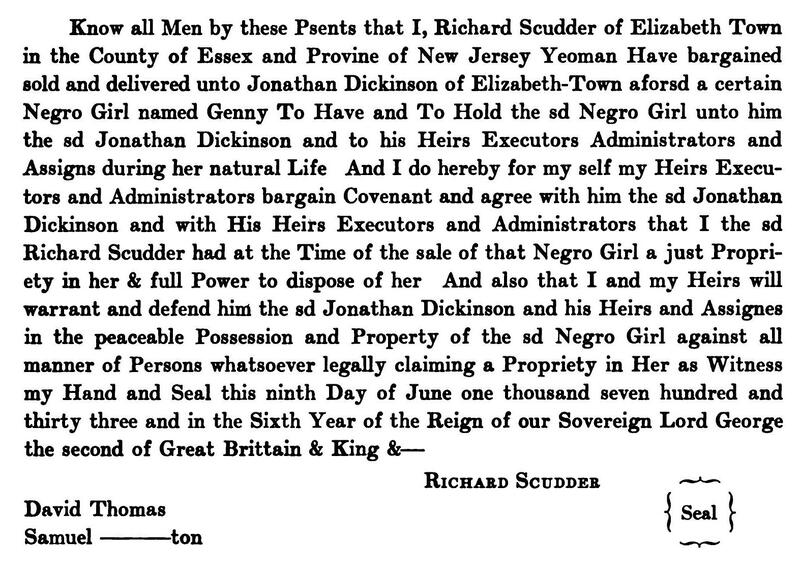
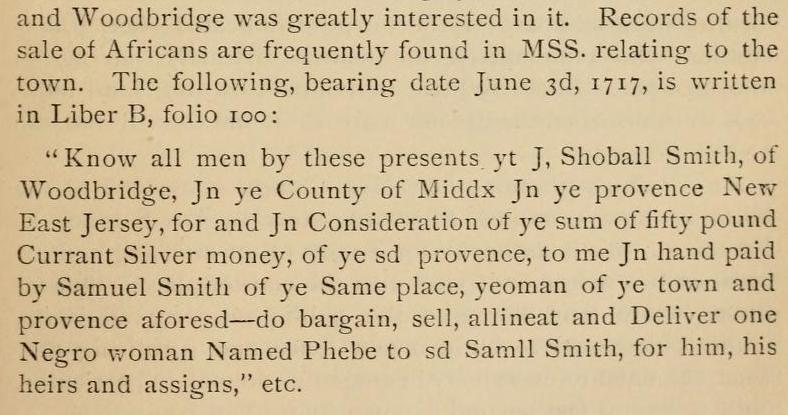
A transcript of the bill of sale for Genny is published in the 1914 book Memorials of Eminent Yale Men by Anson Phelps Stokes. Stokes does not explain where the original document was found. This note appears below the transcript: "This is a bill of sale to Dickinson of a negro girl. It is entirely in his handwriting, and being dated 1733, is an early document of American slavery."
A hand-written bill of sale for York, a fifty-year-old enslaved man sold by Theodorus Van Dyck to Hendrick Van Dyck. The document is dated July 30th, 1742, and includes the signatures of Theodorus Van Dyck and two witnesses including John Hastier, a prominent silversmith in New York City who frequently used slave labor in his workshop.
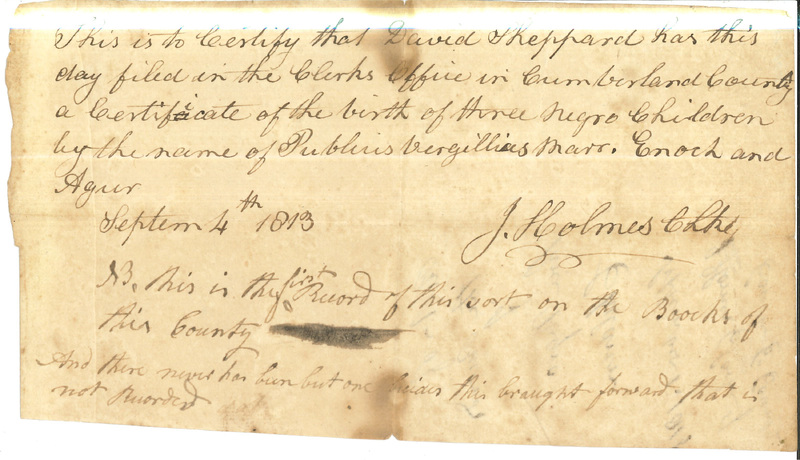
On 4 September 1813, David Sheppard of Cumberland County, New Jersey, reported to the County Clerk that three Black children had been born to an enslaved woman in his household. He received a receipt certifying that he reported the children's births.
The County Clerk, J. Holmes, noted on the receipt that this was the first (and only) time he had received a certification of birth for enslaved children in Cumberland County. Evidently, David Sheppard (and possibly other enslavers in the county) did not comply with the rules laid out by the 1804 Gradual Abolition Act, which stipulated that all children born to enslaved mothers after 4 July 1804 should be reported to the local County Clerk within 9 months of their birth.
Bloomfield is a township in Essex County, New Jersey. It began as a settlement within Newark township in the 1660s and was originally known as Wardsesson. In the late 18th century, the area became known as Bloomfield, after Revolutionary War general Joseph Bloomfield.
Bloomfield broke off from Newark and was incorporated as a separate municipality in 1812. Originally, Bloomfield was about four times larger than it is today. Portions of Bloomfield broke off later in the 19th century to form several surrounding municipalities: Belleville broke off in 1839, Montclair in 1868, and Glen Ridge in 1895. Thus, slavery-era records that mention Bloomfield may be referring to areas in present-day Belleville, Montclair, or Glen Ridge.
Bob was a Black man enslaved by James Lake, whose residence was listed in 1802 as "Somerset, New Jersey, near Princeton." He ran away from James Lake in 1802.
Bob was one of the victims of the Van Wickle slave trading ring. He was on the brig Mary Ann, which took at least 36 Black people from the Raritan Bay to New Orleans in the spring of 1818.
Little is known about Bob. While most victims of the Van Wickle slave trading ring received removal certificates from the Court of Common Pleas in Middlesex County before they departed New Jersey, Bob did not have a removal certificate. His name has not been found in New Jersey records. However, his name appears on the list of enslaved people who arrived in New Orleans in the cargo hold of the brig Mary Ann. Charles Morgan was recorded as his primary enslaver at that time. In early May 1818, he was seized by the New Orleans customs officials (together with all of the other Black people who disembarked from the Mary Ann).
Bob was a Black boy born circa 1789. He was enslaved by Reuben Hunt of Maidenhead, Hunterdon County (present-day Lawrence, Mercer County). Bob ran away from his enslaver in 1805.
Bob was a Black man born circa 1796. He was enslaved by John W. Stiles in Elizabethtown, Essex Count (now Elizabeth, Union County), New Jersey. He ran away from John W. Stiles in 1817.
Bob was born on October 21, 1799, and was enslaved by Joseph W. Hagaman of Princeton, NJ. Under New Jersey law, he had the status of a slave for life. In 1812, Joseph W. Hagaman moved from the state of New Jersey to Ohio and took Bob with him. The removal certificate related to this move stated that Bob had no parents residing in New Jersey.
Bob was born in 1807, the child of Abb (enslaved by Matthias Vanderveer of North Brunswick, NJ). Under the provisions of New Jersey's Gradual Abolition Act of 1804, he was considered a slave for a term of 25 years and would become eligible for emancipation upon reaching that age.
Bob was born in 1807, the child of Betty (enslaved by Henry Cortleyou of South Amboy, NJ). Under the provisions of New Jersey's Gradual Abolition Act of 1804, he was considered a slave for a term of 25 years and would become eligible for emancipation upon reaching that age.
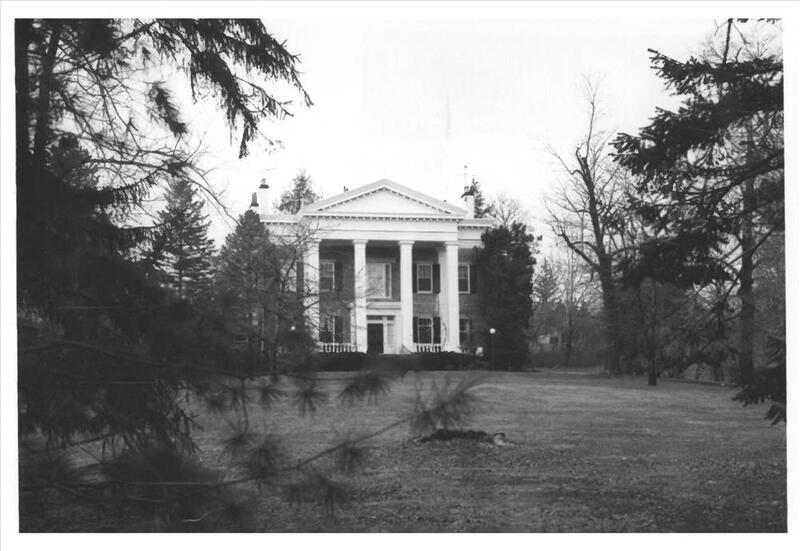
Boisaubin Manor is a Greek Revival-style brick mansion in Chatham, Morris County, New Jersey. It was originally constructed in the early 19th century, probably between 1822 and 1834. The mansion originally stood on a 200-acre plantation. The mansion was built for Vincent Class Van Schalkwyck Boisaubin (1755-1834), a plantation owner from Guadeloupe who escaped from the island during the French Revolution and settled near Morristown in New Jersey. Boisaubin Manor is now on the National Register of Historic Places.
Bonaparte was born in 1805, the child of Hagar (enslaved by John James of East Windsor, NJ). Under the provisions of New Jersey's Gradual Abolition Act of 1804, he was considered a slave for a term of 25 years and would become eligible for emancipation upon reaching that age.
Bonhamtown is a historical community in present-day Edison Township, Middlesex County, NJ. During the era of slavery, the village of Bonhamtown was part of Woodbridge Township (Edison Township did not yet exist as it would be formed after the Civil War from portions of Woodbridge and Piscataway townships). Documents related to slavery in the historical community of Bonhamtown would be found among Woodbridge records.
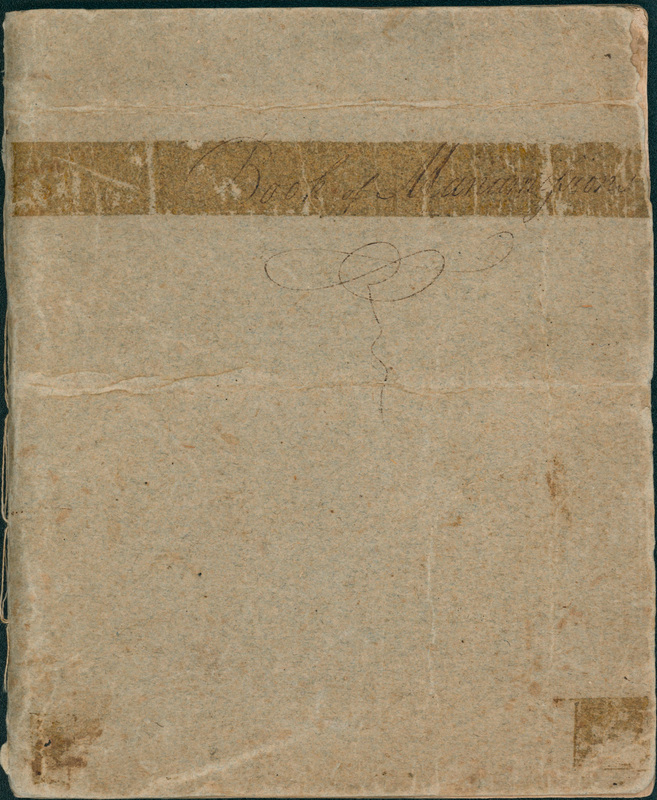
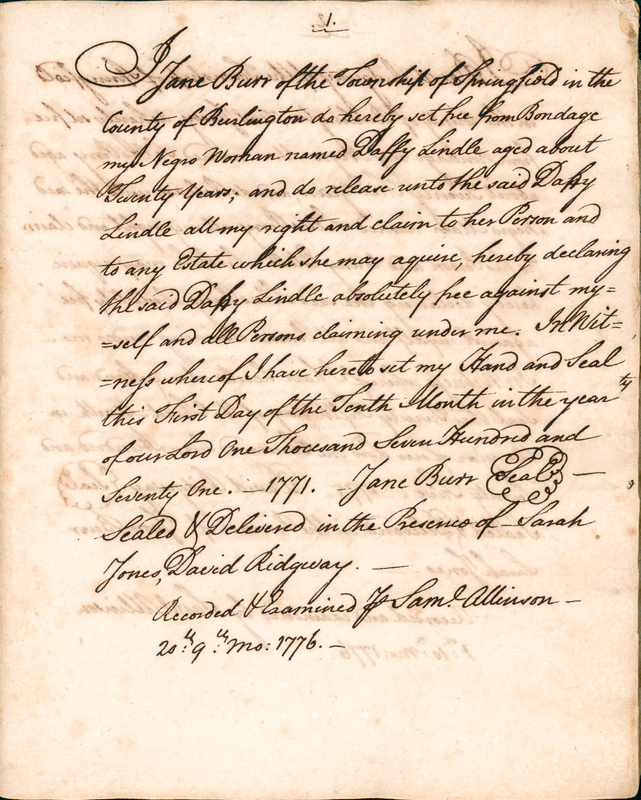
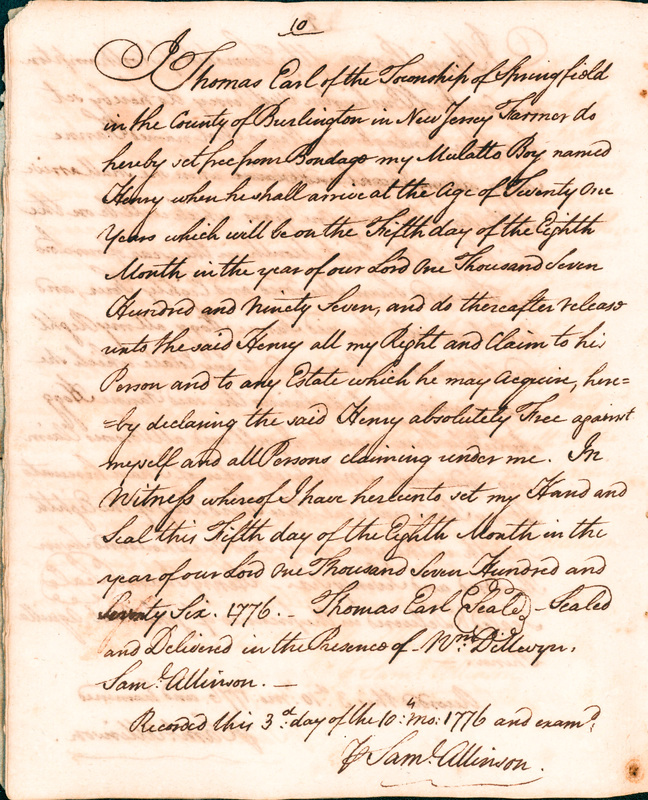
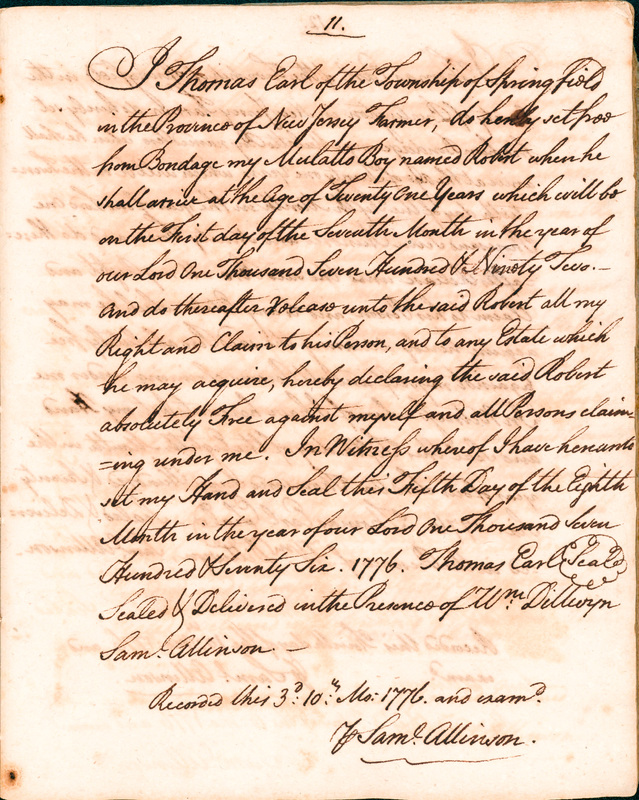
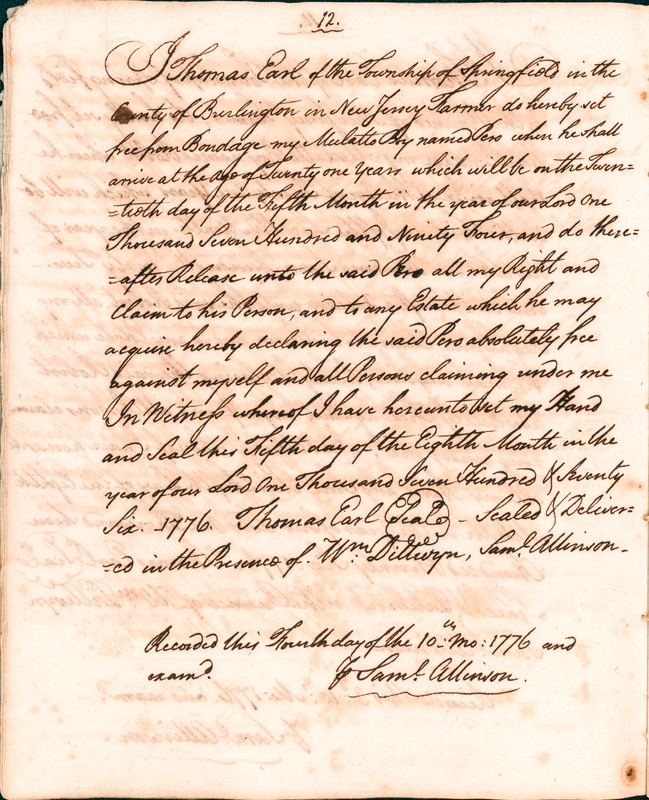
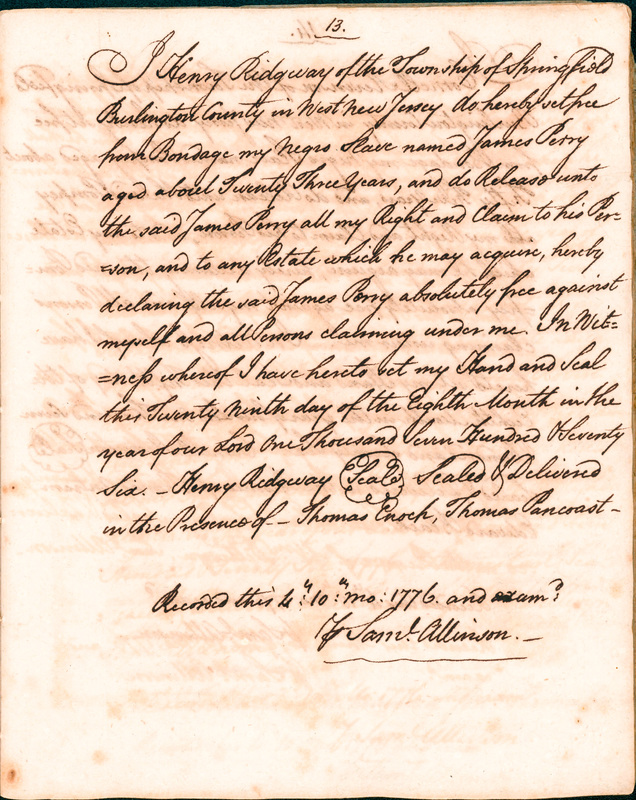
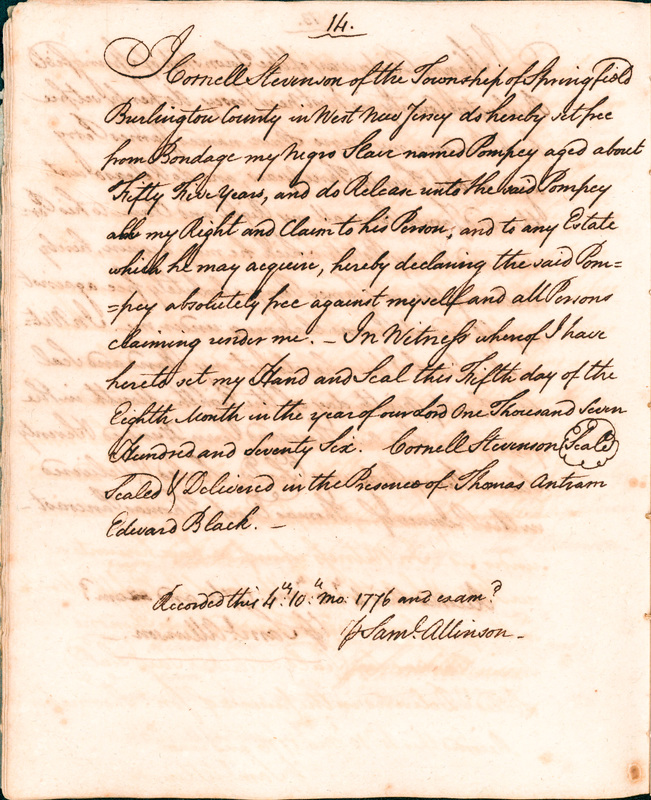
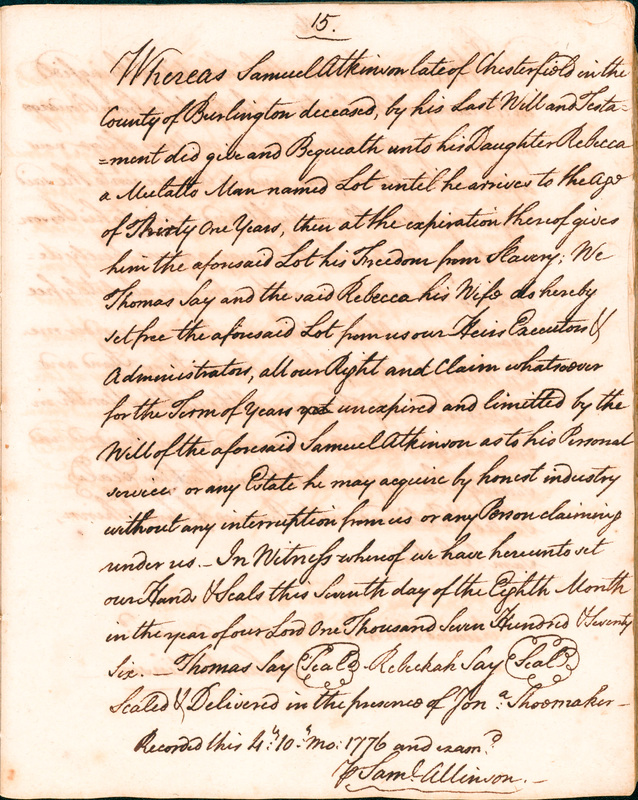
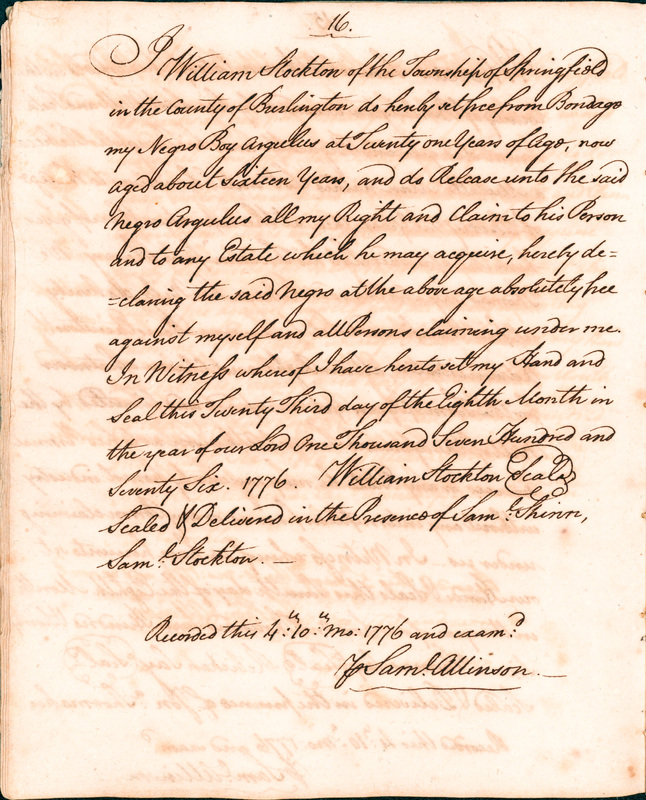
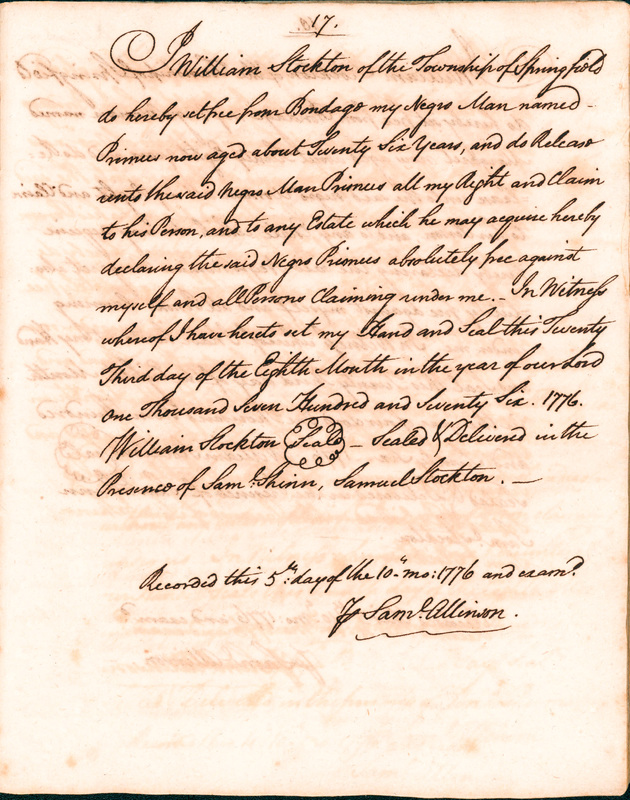
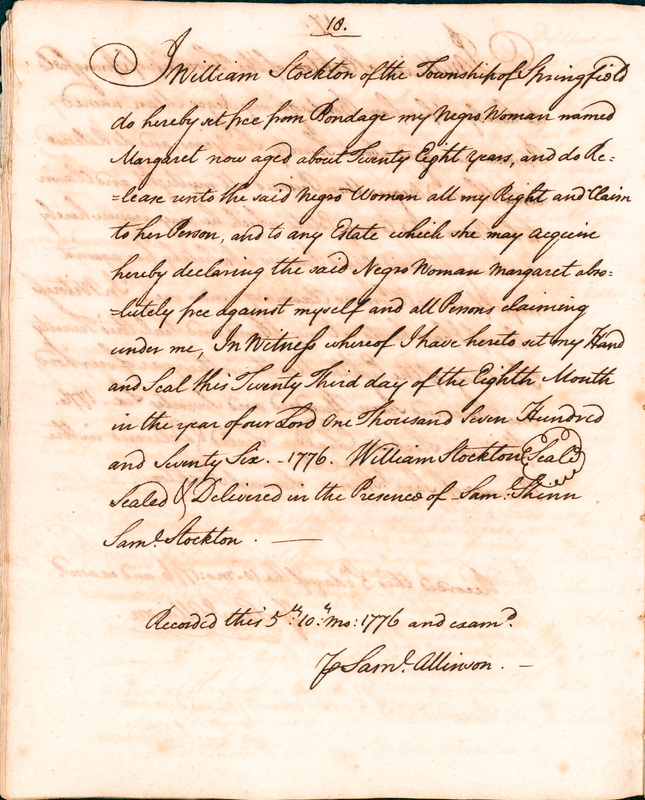
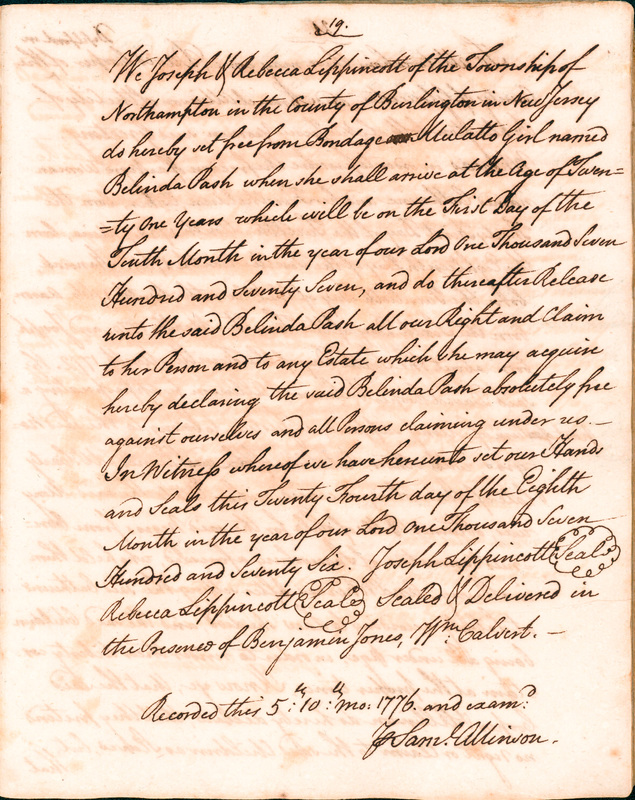
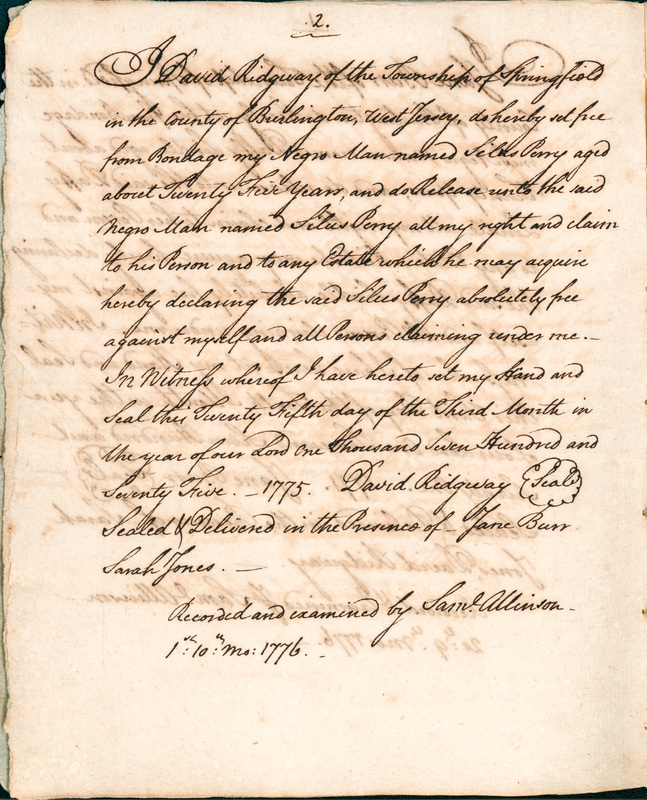
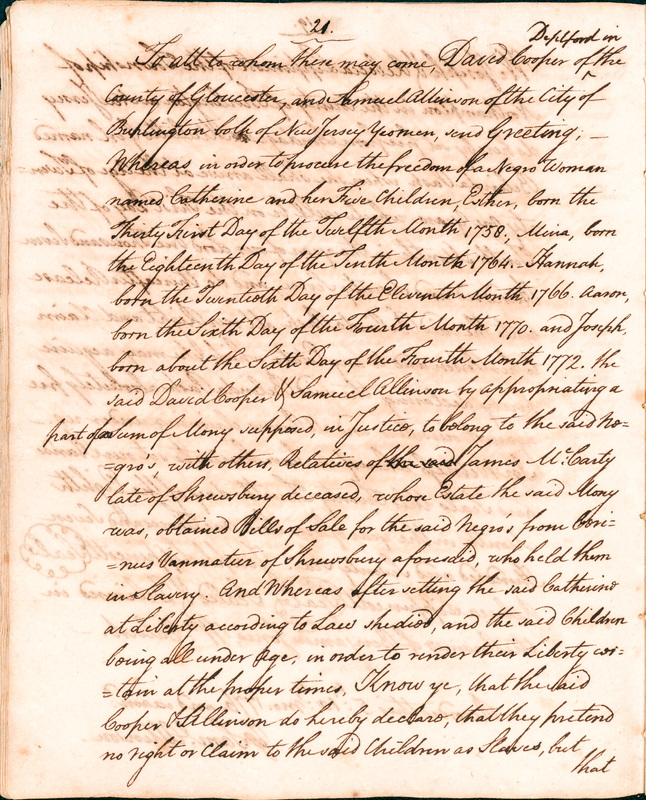
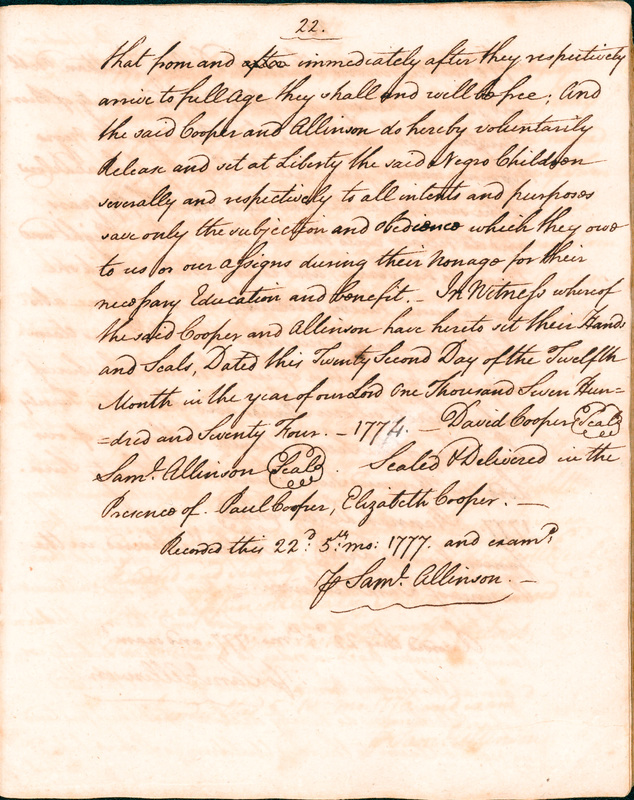
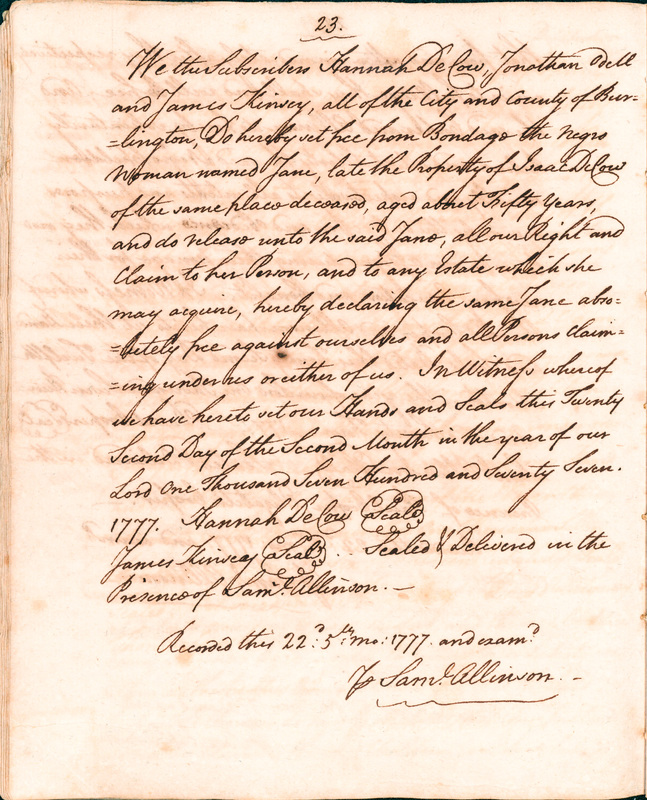
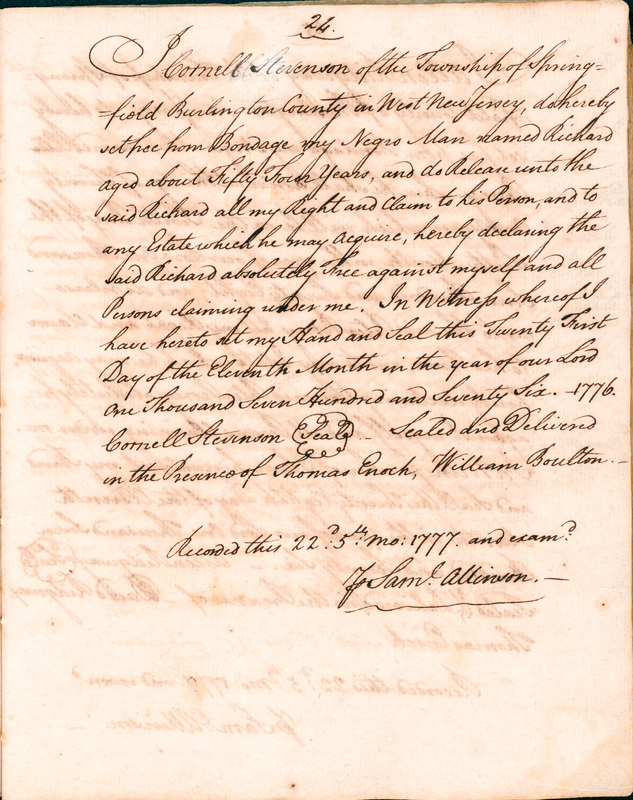
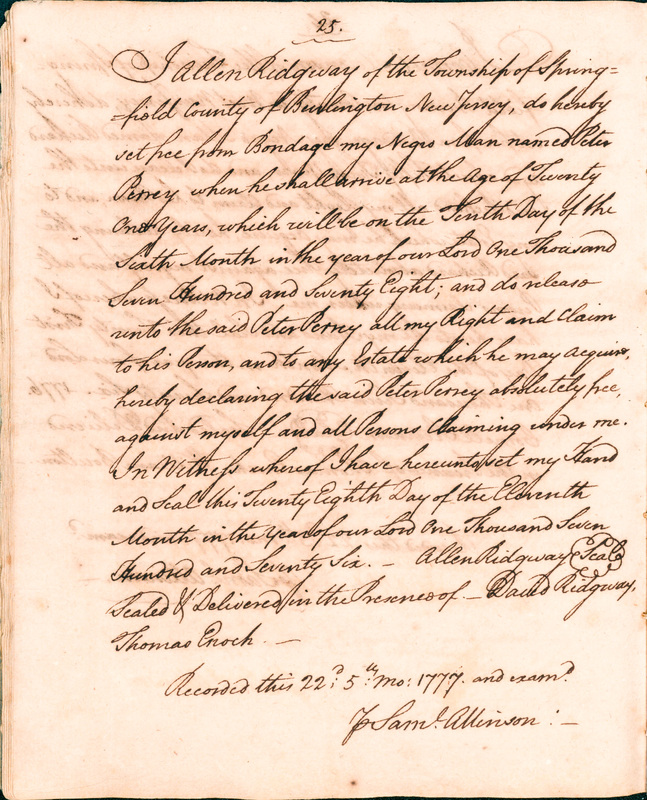
This Book of Manumissions is a slim bound volume written in the hand of Quaker abolitionist Samuel Allinson of Burlington. The book contains handwritten copies of 37 manumission deeds, primarily from Burlington County, with a few records from Gloucester and Monmouth Counties.
Allinson made entries in the book from 1776 until 1781. However, two deeds included in the book were originally executed before 1776. The earliest document was executed in 1771. Each page in the book records one document, and the pages are numbered at the top, going through page 38. Note that Samuel Allinson accidentally skipped the number 20 in his page count, so the book skips from page 19 to page 21, and there are 37 records in total.
In 1981, with the support of the New Jersey Historical Commission, the Burlington County Historical Society published a booklet called Freedom Papers, 1776–1781, which contained black and white facsimiles of these manumission deeds and an informative introduction by Clement Alexander Price. Copies of this booklet are available at the Burlington County Historical Society.
In 2026, the New Jersey Slavery Records team collaborated with the Burlington County Historical Society to scan the Book of Manumissions as part of our effort to digitize the entire Abolition Collection (MSS 5).