Rights & Reproductions
How we collect and publish materials
The New Jersey Slavery Records project does not have physical custody of the archival records represented in the database. The project works to index records and capture data from a variety of primary and secondary sources, including archival family papers, government records, published books, and historical newspapers. A considerable portion of the materials on our website originates from records that are in the public domain.
We also work with archival repositories to scan and publish digital facsimiles of historical documents from their collections. We host the resulting images on our website as fairly lightweight JPG image files. For major digitization projects, we produce high-resolution TIFF files, but we do not retain these high-resolution scans ourselves. Instead, we give these high-resolution TIFF files to the partnering archival institution, and they may choose to license these files to patrons at their discretion.
Additionally, we accept some photographs of historical documents from volunteer researchers who scour archival collections throughout the state in search of records related to slavery. Researchers' images vary in size and clarity and are made available to the public on our website “as is.”
As a result of our work methods, some images we publish are large and crisp, while others are smaller and may include shadows or distortion. In all cases, the image you can download from our website is already the highest resolution and highest image quality that we have in our possession. You are welcome to use the image per the guidelines outlined below. This image quality may or may not meet your specific needs.
If you need a higher-quality image for an exhibit or print publication, please seek an image reproduction from the originating archival institution that holds custody of the physical item. For newspaper clippings, seek out the closest library that has a physical copy, microfilm roll, or digital access to the publication you want.
FAQs
May I use New Jersey Slavery Records data and images for noncommercial purposes?
Yes. New Jersey Slavery Records is licensed under Creative Commons Attribution-NonCommercial 4.0 International license. This means you can share, redistribute, or remix the material for noncommercial purposes, as long as you follow these rules: give appropriate credit, provide a link to the license, and indicate if changes were made to the material.
How do I give proper attribution for materials hosted on this website?
Database records should be attributed to New Jersey Slavery Records, and a link to the relevant page on the website should be included. Each database record has a unique Identifier code, which can be found near the top of that record’s page. Including this code in your citation helps other researchers identify this specific item in the database.
For images of archival documents, in addition to citing New Jersey Slavery Records, it is important to give credit to the archival institution that holds custody of the original physical item. You can find out which institution holds this item by looking at the Archive field.
For portraits of people and pictures of historic sites, we use images that are either already in the public domain or are licensed under a Creative Commons license. Check the Image Rights field on the relevant page for information about where the image originated.
Can I download a source document image from New Jersey Slavery Records?
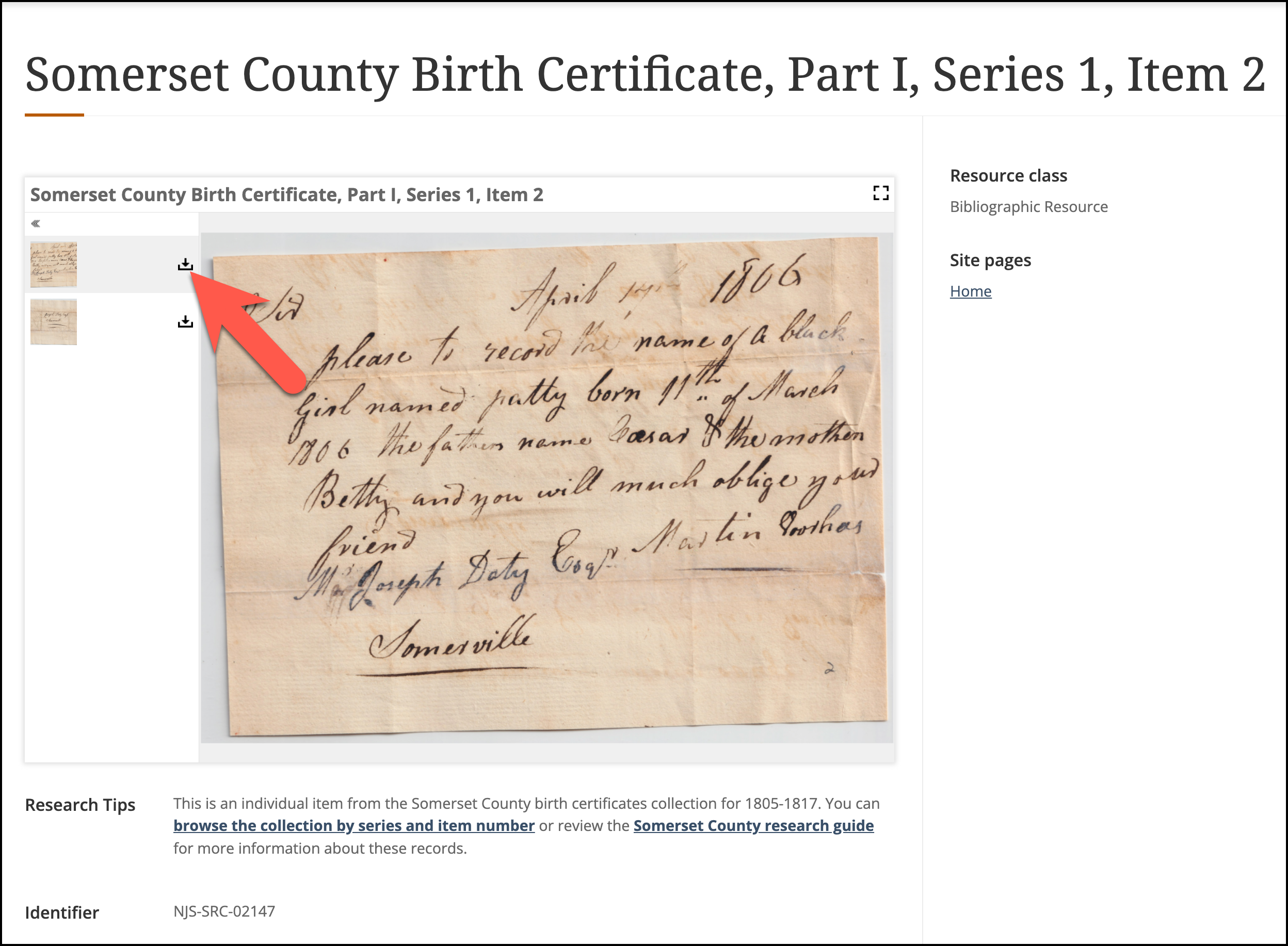
Yes, if the document image is hosted on the New Jersey Slavery Records website, then you can download it. Click the download button on the left side of the image viewer. (See screenshot.)
How can I get a high-resolution image and/or permissions beyond the CC BY-NC license?
For archival documents, please contact the originating archival institution that holds custody of the physical item. The originating institution is listed in the Archive field. The Archival Collection and Archival Location fields will help the archivist find this item in their repository.
For newspaper clippings, seek out the closest library that has a physical copy, microfilm roll, or digital access to the publication you want. You may then be able to create a higher resolution image if the necessary equipment is available at your library. All 18th- and 19th-century newspaper articles are in the public domain, so you do not need permission to reproduce newspaper articles.