Somerset County Slavery Records
Table of Contents
Somerset County Historical Note
Somerset County is located in the central part of New Jersey, and its county seat is Somerville. It was one of the earliest counties formed during the colonial era. Many communities in the county were originally established by Dutch settlers. Historically, slavery was central to the development of Somerset County, with both Dutch and English settlers relying on enslaved labor for agricultural and domestic work.
County boundaries shifted considerably over time, and Somerset County records are crucial for researchers of slavery in the areas surrounding Rutgers and Princeton, even though neither of these schools are located in Somerset County anymore. Somerset County was formed in 1688 from portions of Middlesex County and Essex County. The county later increased in size by annexing another section of Essex County in 1741. In 1838, Somerset County's southern section around the area of Princeton was taken to form a part of the new Mercer County, but pre-1838 records for the area are still held by Somerset County. Moreover, prior to 1850, Albany Street in New Brunswick served as the county boundary between Somerset and Middlesex County, and thus the City of New Brunswick was actually split in half. A portion of the city (most of today's downtown) was located in Middlesex County and another portion (including all of the Rutgers College Avenue Campus) was officially in Somerset County. This situation was remedied in 1850 when the county boundary was redrawn to move all of New Brunswick into Middlesex County, but records prior to 1850 remain at the Somerset County offices in Somerville. Due to this complex history of boundary changes, Somerset County slavery records in the New Jersey Slavery Records database include some documents related to New Brunswick (which is now fully in Middlesex County) and Princeton and the surrounding area (which is now in Mercer County).
For additional information about the county and all of the places within it, see the Somerset County place record in our database. That record links to all places that are presently in Somerset County and also provides a separate list of places that were previously in Somerset County. Alternatively, use the PLACES browsing page where you can quickly filter places by county. The EVENTS browsing page also allows you to filter records by modern or historical county.
Demographics and Slavery in 1800
The enslaved population of New Jersey grew after the American Revolution and reached its peak on the 1800 federal census (the last census before the start of the state's gradual abolition program).
In 1800, Somerset County had 2,038 Black residents and was second only to Bergen County in key categories related to Black people and enslavement: second highest percentage of Black residents (15.9%), second largest number of enslaved persons (1,863), second highest enslaved population percentage (14.5% of the total population), and second highest rate of enslavement for Black residents (91.4% of Black residents living in slavery). Somerset had 175 free Black residents (8.6% of the Black population or 1.4% of the total population of the county). The total population of the county was 12,815, ranking 10th among New Jersey's 13 counties by population.
Digitizing Somerset County Clerk's Records
In the early 19th century, County Clerks in New Jersey were responsible for registering the births, manumissions, and relocations of enslaved people. These records provide key documentation about Black people's lives in the era of Gradual Abolition in New Jersey, which began in 1804. The Somerset County Clerk's Office in Somerville holds the original records for the county.
In 2024, the New Jersey Slavery Records team partnered with the Somerset County Clerk's Office to digitize their slavery records and make them accessible to researchers via our website. Undergraduate research assistants Saketh Mandayam and Daniel Dias assisted with this digitization project and began the work of collecting data from the documents.
We have completed the first phase of the digitization project and published the scans—over 1,600 images. During the next phase of the project, we will work to index the names, events, and locations represented in these documents to make them searchable in our database.
You can learn more about these documents and browse all of the images using the links below.
Browsing County Clerk's Records
Today, the Somerset County Clerk's slavery records are kept in five archival binders. We have scanned each binder as a separate collection.
Originally, these archival records were a mixture of loose original documents and bound registers that the clerk used to record copies of the documents he received. A preliminary review of the collections indicates that there is considerable overlap between the originals and the bound registers. However, it appears there were a few loose documents that were not copied into the registers, and, conversely, there are some items in the bound registers that do not have an equivalent original on file.
We suggest starting your research with the bound registers. The registers have an advantage in that the County Clerk kept an alphabetical index inside each book. The loose papers do not currently have an index.
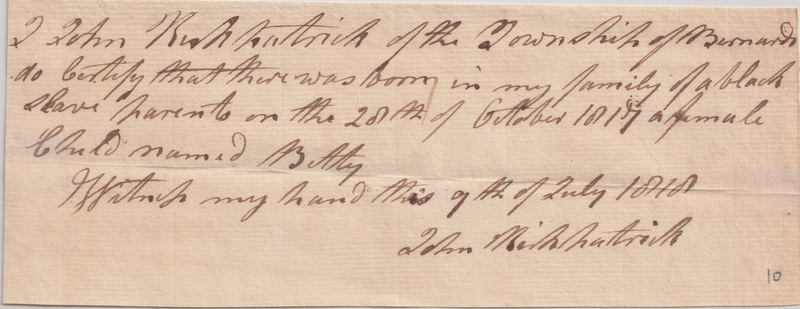
Somerset County Birth Certificate, Part II, Series 1, Item 10
Birth of Betty, reported by John Kirkpatrick
Loose Papers
The first two binders contain original loose birth certificates of Black children born to enslaved mothers. These slips of paper were submitted to the clerk by enslavers.
- Certificates of Births of Black Children and Slaves, 1805-1817
- Certificates of Births of Black Children and Slaves, 1818-1840
A third binder contains loose manumissions and removal certificates received from enslavers and government officials between 1804 and 1841. Manumission is the act of releasing an individual from slavery. Note that, although this binder says "Manumission or Slave Records" on the cover, many of the documents contained here are not manumissions, but rather records of removal of Black New Jerseyans who were trafficked to Louisiana and other destinations in the Deep South in 1818. These records indicate that Somerset County residents and officials were part of a human trafficking scheme, much like Judge Jacob Van Wickle's slave trading ring in Middlesex County. See our Guide to Removal Certificates for help understanding these documents.
- Manumission or Slave Records (Loose Items)
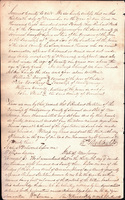
Somerset County Register of Black Children and Manumissions, Book B, Page 1
Manumission of Thomas by Richard Stockton
Bound Registers with Index
The last two collections are two Registers that span from 1804 to about 1850. These were books that the County Clerk used to record copies of the loose documents he received. Note that the binder covers do not clearly reflect the contents of these books. The first book is marked "Register of Black Children Book A," and the second "Manumission and Register of Blacks." In actuality, both registers contain a mixture of birth certificates, manumission records, and removal certificates. Unlike some other counties where birth and manumission records were kept in separate books, the Somerset County Clerk simply entered all documents he received into the same register. The first register (Book A) spans 1804-1823, and the second (Book B) spans 1823-1850.
Each register has an alphabetical index compiled by the original County Clerk. If you are looking for a specific name, consult the index to find out what page numbers have relevant records.
- Register of Black Children, Manumissions, and Removals (Book A) 1804-1823
- Register of Black Children and Manumissions (Book B) 1823-1850