Understanding Ship Manifests and the Interstate Slave Trade
by Denise Rompilla
Ship manifests provide crucial information about enslaved people who were trafficked from New Jersey to New Orleans and other Southern slave markets. This guide highlights the laws that governed the slave traffic and established the requirements for ship manifests. It then provides a detailed, illustrated explanation of the manifest for Charles Morgan’s Sloop Thorn, which took 39 enslaved people from Perth Amboy to New Orleans in 1818.
Table of Contents
Laws Governing Ship Manifests
The laws governing the slave traffic had roots in the U.S. Constitution, which addressed the international slave trade, but did not mention the movement of Black people between the states. When the fifty-five delegates from Northern and Southern states gathered for the Constitutional Convention in Philadelphia in 1787, the future of slavery and human trafficking in America were hotly debated issues. In an effort to reach an agreement despite stark differences of opinion, the delegates reached a compromise that skirted the issue of the slave trade and prevented Congress from revisiting the issue for another twenty years.
The agreed-upon compromise is reflected in Article 1, Section 9, Clause 1, of the Constitution, which stated that Congress could not prohibit the “migration or importation” of persons into the country until the year 1808. Individual states, however, could prohibit the slave trade as they saw fit, and New Jersey quickly moved to ban the trafficking of African captives into the state in 1788. The U.S. Congress took up the issue again in 1807 and passed legislation to prohibit the importation of African slaves that March. The prohibition took effect on January 1, 1808, with “An Act to Prohibit the Importation of Slaves into any Port of Place Within the United States.”
“An Act to Prohibit the Importation of Slaves” did not, however, ban the interstate slave trade—the movement of enslaved people from one state to another, along U.S. coastal waterways. Nor did it put restrictions on the movement of enslaved people on the country’s interior waterways such as the Mississippi River and its tributaries. It did, however, regulate that trade to a certain extent in Sections 9 and 10 of the Act. The Act outlined the requirements for ship manifests, which had to record the name, sex, age, and stature of each enslaved person transported aboard the vessel. The Act also prohibited smaller vessels under 40 tons from transporting enslaved people for sale.
Section 9 regulated the procedure before departing from a port of origin:
. . . . That the captain, master, or commander of any ship or vessel of the burthen of forty tons or more...sailing coastwise, from any port in the United States, to any port or place within the jurisdiction of the same, having on board any negro, mulatto, or person of colour, for the purpose of transporting them to be sold or disposed of as slaves, or to be held to service or labour, shall, previous to the departure of such ship or vessel, make out and subscribe duplicate manifests of every such negro, mulatto, or person of colour, on board such ship or vessel, therein specifying the name and sex of each person, their age and stature, . . . [and] the captain, master, or commander, together with the owner or shipper, shall severally swear or affirm . . . that the persons therein specified were not imported or brought into the United States [after January 1, 1808], and that under the laws of the state, they are held to service or labour; whereupon the said collector or surveyor shall certify the same on the said manifests, one of which he shall return to the said captain, master, or commander,... and authorizing him to proceed to the port of his destination.
Section 10 regulated the procedure before docking at the port of destination:
That the captain, master, or commander ... shall, previous to the unlading or putting on shore any of the persons aforesaid ... deliver to the collector, if there be one, or if not, to the surveyor residing at the port of her arrival, the manifest certified by the collector or surveyor of the port from whence she sailed, as is herein before directed, to the truth of which, before such officer, he shall swear or affirm, and ... the collector or surveyor ... shall thereupon grant a permit for unlading or suffering such negro, mulatto, or person of colour, to be put on shore...
Failure to present a certified copy of a ship’s manifest upon arrival in the port of destination held steep penalties. The captain of the ship faced a fine of 1,000 dollars for every person of color on board, while the ship’s owner faced a fine of 10,000 dollars. Both were at risk of being “seized, prosecuted and condemned in any court of the United States having jurisdiction thereof.” U.S. Customs officials were also authorized to take possession of the vessel and its cargo – which in the case of these vessels, meant people. Ships were auctioned off to the highest bidder, while the enslaved people were taken into custody by the local sheriff, warehoused in the city’s jails, and sold at public auction, with a portion of those proceeds set aside for the commanding officer who seized the vessel. Ultimately, the fate of the seized enslaved people often remained the same, even if it became clear that they had been illegally trafficked to the South. They did not usually gain freedom, but were rather sent to toil as unpaid laborers on Southern plantations.
This manifest for the Sloop Thorn is an outbound or “outward” manifest, meaning it is a document that was drawn up and presented to the port collector before the vessel departed from the port of origin. At this time, the Collector of Perth Amboy—the man in charge of inspecting vessels at the port—was John Brewster.
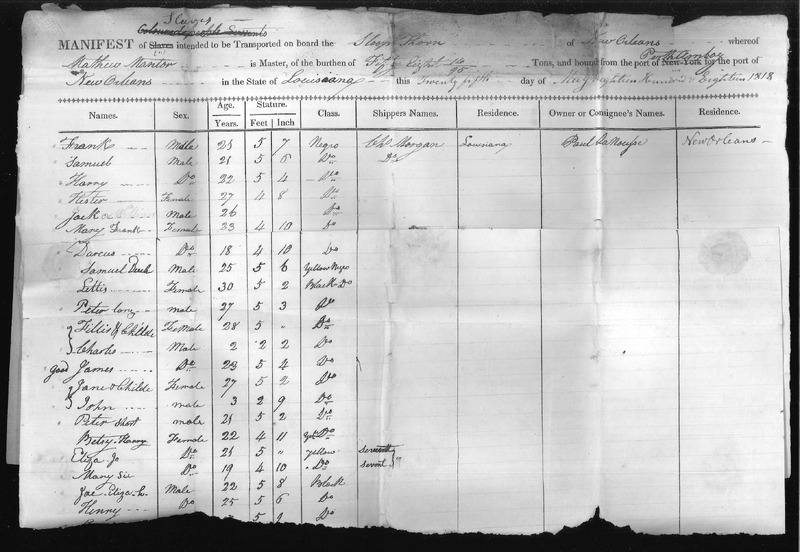
Manifest for Sloop Thorn
Manifest for Sloop Thorn, May 25, 1818. Box 18: Outward Cargo Manifests April 1814–1821. Collection District of Perth Amboy, Cargo Manifests, 1801-1877 (NAID: 4526669). Record Group 36: Records of the U.S. Customs Service. National Archives at New York City.
Ship manifests used standard pre-printed forms with columns for recording information about the people on board. The Port of Perth Amboy used the same pre-printed forms as the Port of New York, simply crossing out “New York” and replacing it with “Perth Amboy” wherever the words “New York” appear on the form.
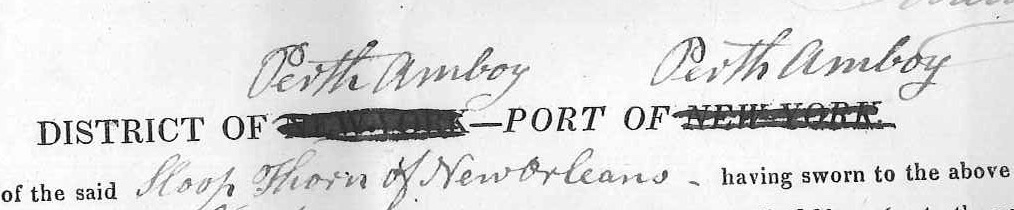
At the top of the form, Matthew Mantor is listed as the ship’s master, i.e., the captain. The burthen, i.e. the vessel’s carrying capacity, is listed as 58 14/95 tons. New Orleans is listed as the destination. Notably, the top of the pre-printed sheet says “Manifest of Slaves intended to be Transported”; here the word “slaves” has been crossed out, replaced with “coloured servants,” and then crossed out again and replaced with “slaves.”

The next section of the form contains a table of names. Here, Charles Morgan of Louisiana is listed as the shipper of the people on board, and Paul Lanusse of New Orleans is listed as owner or consignee, i.e., the receiver of the shipment.

There are 30 handwritten names of enslaved people on the surviving document; however, the manifest has been torn, and a section of the manifest is missing. The complete manifest once contained 39 names, as indicated on the last page of the form that says "Thirty nine slaves" were recorded on board. Individuals are listed by Name, Sex, Stature (height in feet and inches), and Class, which is used here to classify people by skin color (Negro, Black, Yellow, Light). The abbreviation "Do." means ditto, i.e., same as the line above.
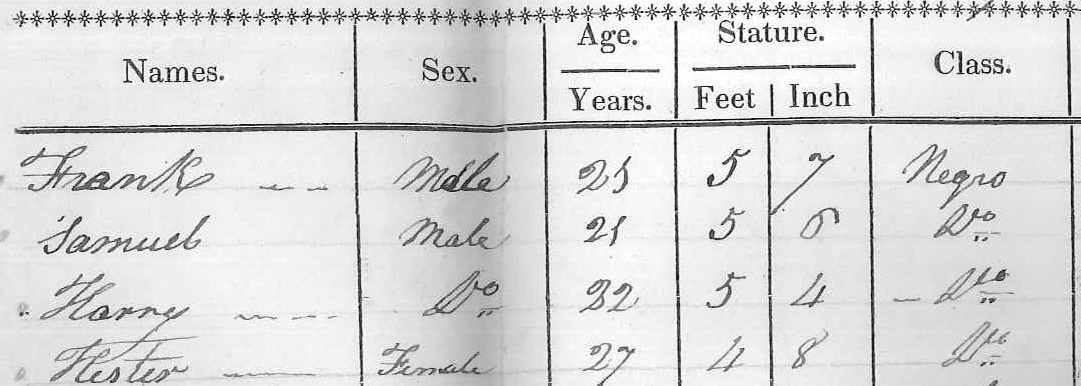
Most individuals are identified by first name only, and in the cases where two individuals have the same name, modifiers are attached to describe differences in temperament, height, or color (“Good” James, “Yellow” Hannah). There are three married couples listed on the manifest: Mary and Frank; Betsey and Harry; Eliza and Joe. The youngest child on the surviving manifest, Charles, is two years old. Two individuals are listed as “servants.”
Most of the names on this list match certificates of removal that were issued by Judge Jacob Van Wickle (Charles Morgan's brother-in-law) between March and May of 1818. Those removal certificates were entered into the so-called Book of Manumissions for Middlesex County. However, a careful comparison of the removal certificates and this manifest reveals significant discrepancies when it comes to the age recorded on the documents. For many people, the age listed on the manifest appears to be inflated to make them seem older than they really were. For example, Eliza’s removal certificate said she was 19 years old, but the manifest said she was 21; Henry’s removal certificate said he was 21, but the manifest said he was 25.
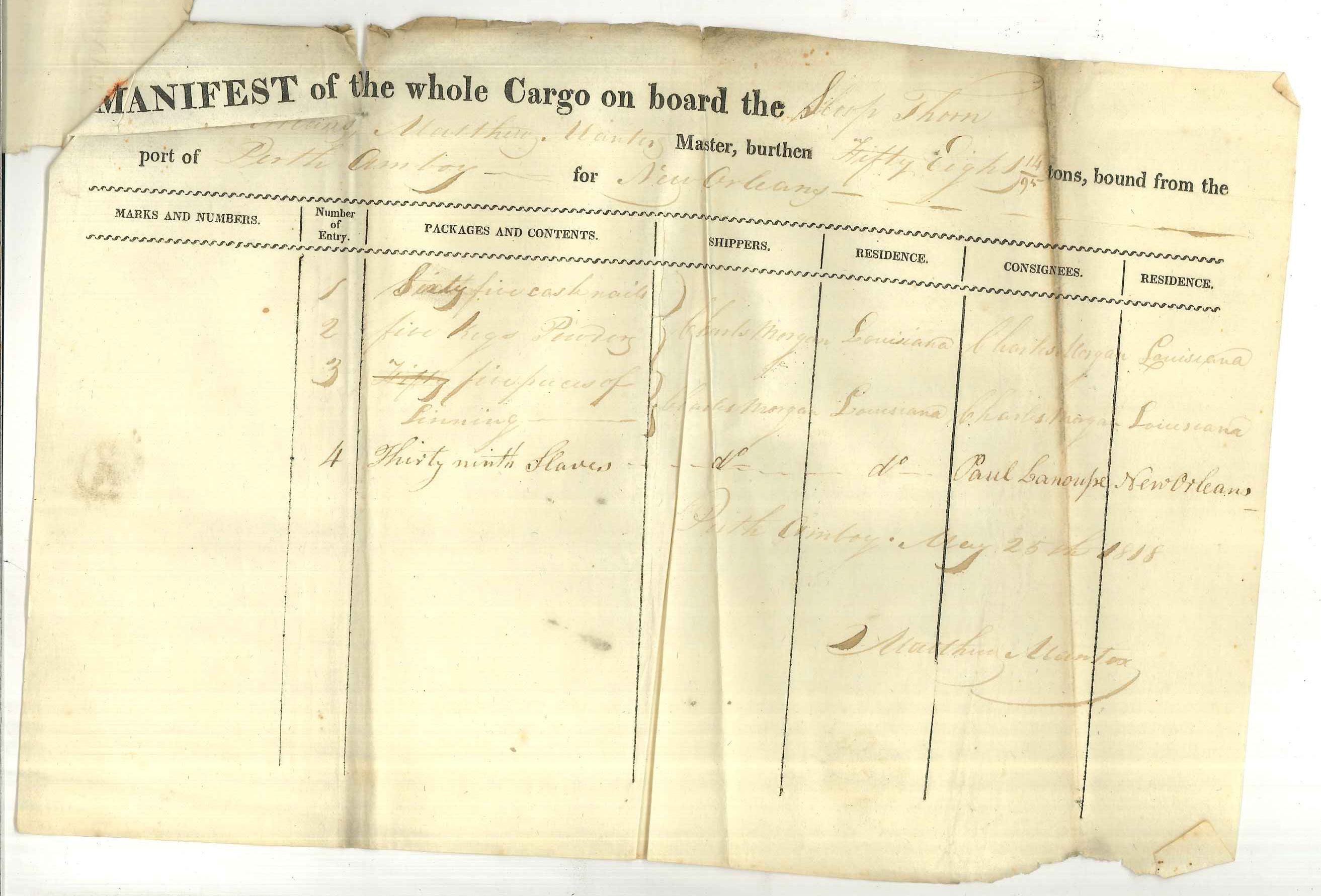
Vessels employed in the coastal slave trade often served a dual purpose in that they were also used to ship manufactured goods from North to South. In reading the cargo lists for these manifests, it can be shocking to see human beings tacked on to a list of quotidian objects. On the “Manifest of the Whole Cargo on board the Sloop Thorn,” the cargo is listed as:
- Sixty-five cask nails
- Five kegs Powders
- (Fifty crossed out) Five pieces of Linning
- Thirty-ninth [sic] Slaves
The first three items on the cargo list are earmarked for Charles Morgan of Louisiana, and the 39 people are consigned to Paul Lanusse of New Orleans.
Charles Morgan's Slave Trafficking
This voyage of the Sloop Thorn was the second time that Charles Morgan used the vessel for human trafficking. Charles Morgan bought the Sloop Thorn sometime between his arrival in New Jersey in January 1818 and March of that year. He first used the sloop to smuggle a group of 36 Black people out of the port of Perth Amboy in early March. Morgan bought these people in New Jersey and wanted to take them to New Orleans clandestinely. Rather than filling out the requisite paperwork and sending the Thorn directly to New Orleans, he sent the sloop to meet up with a brig called Mary Ann near Sandy Hook. Mary Ann had sailed from the port of New York on March 10th and docked off Sandy Hook to receive its smuggled cargo from the Thorn. The Mary Ann successfully evaded patrols in the harbor and arrived in New Orleans sometime between May 10th and May 15th but was seized under suspicion of smuggling, and its captain was prosecuted in court for failure to provide a proper manifest.
Morgan seems to have taken greater care to follow procedure for this second voyage, possibly because the consignee (the receiver and owner of the enslaved people on board) was Paul Lanusse of New Orleans. Lanusse, who had emigrated from France and set up operations in New Orleans by 1802, was part of the business elite, having been a successful planter, merchant, officer of the Bank of Louisiana, and slave trader. Once in the hands of Lanusse, the individuals on board the Thorn probably would have been destined for the New Orleans slave market, to be sold off in ones or twos. This bleak outlook directly contradicts the life that had been promised to the departing Black New Jerseyans and the language in the certificates of removal, in which the consent of each enslaved person was recorded to have been given in front of two New Jersey judges, to “serve Charles Morgan and / or Nicholas Van Wickle in Pointe Coupee Louisiana.” (Nicholas Van Wickle was Charles Morgan's nephew who assisted him with the scheme.)
With the purchase of his own ship, access to New Jersey slaves, legal cover by his brother-in-law Jacob Van Wickle and other judges, and the financial backing of a prominent New Orleans merchant experienced in the slave trade, Charles Morgan may have been attempting to establish his own slave trading company a decade before Isaac Franklin and John Armfield created their notorious trafficking firm. Such aspirations, however, were cut short by the seizure of the Thorn for irregularities with the ship’s manifest; indictments handed down in June of 1818 by the Court of Oyer and Terminer for the illegal removal of three adults and fourteen children from New Jersey; and the eventual passage of a new stricter law in November 1818 by the New Jersey state legislature forbidding the exportation of New Jersey’s enslaved people to Southern states.
Further Readings
An Act of March 2, 1807, 9th Congress, 2nd Session, 2 STAT 426, to Prohibit the Importation of Slaves; 3/2/1807; Folder 9, Leaf 87, Public Law, 9th Cong., 2nd Sess.: An Act to Prohibit the Importation of Slaves into Any Port or Place Within the Jurisdiction of the U.S. From and After Jan. 1, 1808, March 2, 1807; Enrolled Acts and Resolutions of Congress, 1789 - 2011; General Records of the United States Government, Record Group 11; National Archives Building, Washington, DC. [Online Version, https://www.docsteach.org/documents/document/act-prohibit-importation-slaves, June 16, 2024]
Gigantino, James. The Ragged Road to Abolition: Slavery and Freedom in New Jersey, 1775-1865. Philadelphia: University of Pennsylvania Press, 2016.
Johnson, Walter. Soul by Soul : Life inside the Antebellum Slave Market. Cambridge: Harvard University Press, 2009.
Rothman, Johsua D. The Ledger and the Chain: How Domestic Slave Traders Shaped America. New York: Basic Books, 2021.
Schermerhorn, Calvin. The Business of Slavery and the Rise of American Capitalism, 1815-1860. New Haven, Ct: Yale University Press, 2015.
Slave Ship Manifests filed at New Orleans, 1807-1860. Research Our Records: African American Heritage, National Archives. https://www.archives.gov/research/african-americans/slave-ship-manifests.html
Wesley, Charles H. “Manifests of Slave Shipments Along the Waterways, 1808-1864.” The
Journal of Negro History 27, no. 2 (1942): 155–74. https://doi.org/10.2307/2714731.